vovat: (wart)

I'm sure you know by now that cartoons based on video games were an important part of my formative years, which is probably why I'm so messed up now. And if you've watched any of these cartoons, you know how many odd changes were made from the actual games, especially in Captain N. Wanting to know whether these were simply the whims of clueless executives or matters with valid explanations, I once again consulted the Mushroom Guru. And I finally uncovered the Star Road that leads to the top, so no more tedious treks up Giant Snowy Mountain, or whatever that place is called!

Q: So, first of all, what's with King Hippo? Why did he change from flesh-colored to blue?
A: You'll notice that, in the game, he had a bandage over his belly, where he was weak. In an attempt to solve this problem, he drank an untested gypsy remedy, which turned his skin blue. It also contained a fair amount of estrogen, which is why his breast size increased.


Q: Princess Lana wasn't in any games, was she?
A: Actually, believe it or not, she was one of the villains in the game Super Glorious People's Devil Revolution Happy Fun Positive Thinking Jihad, which was never released due to its controversial mixture of philosophies, including communism, Satanism, pop psychology, and Islam. What's known of it is that it involves the main characters overthrowing the monarchy, and Princess Lana and her father King Charles are both bosses.


Q:Why was Captain N always claiming he remembered things from video games when they didn't actually happen in the games?
A: Well, people who play a lot of video games tend to dream about them. (Editor's Note: I know I do.) And heroes often have prophetic dreams. So Captain N, as both a gamer and a future hero, would occasionally dream about events from games that weren't actually in them, but were things he would later experience in Videoland. His memory tends to confuse the two, as happens sometimes. I still can't remember whether that yeti I saw the other day was a dream or reality.

Q: Why are the characters in the Super Mario Bros. 3 cartoon always referring to Earth as the Real World? Wouldn't the Mushroom World be MORE real to them?
A: It's actually a reference to the explorer Russula Real, the first inhabitant of the Mushroom World to successfully warp to Earth and back.

Q: Why is King Koopa bald in the cartoons?
A: His hair burned off when he fell into the lava at the end of the first game. That's also why he's never shown breathing fire in the show. Doctor's orders, you know.


Q: Why didn't Wart appear on the show?
A: He had a LONG recovery period after being taken out with those vegetables. It was a few years before he was even able to move around on his own. And he was too big for Ostros, so he made a group of Shyguys push him around in a wheelchair.

Q: What's with the flying Birdos? They don't fly in the game!
A: Of course not! They're all guarding specific areas. What kind of guards would they be if they flew off and abandoned their posts?


Q: Why did the Koopalings have different names?
A: Aliases, to try to throw the police off their track. It didn't really work, though.

Q: Why does Link talk in the cartoons, but not in the games?
A: How would you like it if someone were saying, "Excuse me, Princess!" every five minutes? Eventually Zelda got fed up and cast a Mute spell on him.

Q: But isn't there more than one Link?
A: Yes, but they're all...linked. Get it? Seriously, it's due to the transmigration of souls.


That's all for this week. And if you haven't read my previous Mushroom Guru columns, here are Part 1 and Part 2.
vovat: (Default)

In the Zelda games, Impa is Princess Zelda's nursemaid and caretaker. Interestingly, she's a character who originally appeared only in the instruction manuals, but eventually made her way into the actual games. The instructions for the first two games identify her as the one who provided Link with the back story. It's in Ocarina of Time that she first makes an in-game appearance. Here, she explains that she's a Sheikah from the chicken-raising Kakariko Village, one of the Sages, and Zelda's protector. As with Link and Zelda, there are presumably several different Impas, all serving the royal family throughout the generations. The Impas vary somewhat in appearance, with the Ocarina Impa being particularly thin, and the one in the Oracle games rather stout.


Since today is the tenth of March, which looks sort of like "Mario" when written out as "MAR 10," the question of whether Nintendo's other main princess has a servant similar to Impa. I think the closest equivalent is Toadsworth, Princess Peach's loyal valet and attendant. He doesn't actually make an appearance until Super Mario Sunshine, which has him visiting Isle Delfino with Mario and the Princess. After that, however, he became a fixture in the games, often providing items or advice, but other times just fretting about the trouble Peach always gets into. Toadsworth has been misidentified as the Princess' father, but the games themselves make it clear that he works for her. Oh, and according to one of the Mario Golf games, his signature mustache might actually be a fake.
vovat: (Default)

For all of the Links and Zeldas who have teamed up to fight Ganon and his minions throughout the history of Hyrule (not to mention alternate timelines), it's interesting that I don't think any of them ever got together romantically. There's apparently even been some online speculation that Link might be gay, although I don't know that he's shown interest in any males either. With this in mind, it's interesting that DiC's Zelda cartoon, made when there was only one game out [1], really played up the sexual tension between the hero and the princess. The cartoon was part of the Super Mario Bros. Super Show, aired on Fridays in lieu of a Mario cartoon. It appears to be a not uncommon opinion on the Internet that the Zelda cartoons were better than the Mario ones, and I will admit that they apparently took slightly more care with the Zelda episodes (although still not THAT much, since it WAS a DiC production, after all). In the show, Link was constantly hitting on Zelda in the most obnoxious ways possible, and there were occasional hints (especially in the episode "The Missing Link") that the princess secretly returned his affections but didn't want him to know. Another recurring character was Spryte, a fairy who had a crush on Link despite being much, much smaller than him. [2] It's Peter Pan and Tinker Bell all over again, I suppose. I guess it's Link's fault for dressing in that green outfit. And, of course, Ganon was there, and he was very hands-on in this take. He was always showing up in person to steal the Triforce of Wisdom, and insisting that nothing could stop him when he had both Triforces together, even though someone always did. I believe most of the monsters from the first game showed up at some point or other, but they were all morons. One odd rule on the show was that the monsters never actually died, but simply regenerated back in Ganon's Evil Jar, a fixture of his underworld throne room where he kept his henchmen when he didn't need them. They always were reluctant to imply actual death in cartoons of the era, so perhaps that was their way of avoiding it, but I suppose that regeneration kind of makes sense for video game characters anyway.


As with most shows, especially ones aimed at kids, there was never any real continuity. There was always some lame excuse for why Link and Zelda didn't just take the Triforce of Power that Ganon left out in the open. And of course the two heroes never got together; I suspect people would have complained of the show jumping the Zora if they had. When they appeared in a few Captain N episodes, however, they no longer bickered all the time, and Zelda did occasionally kiss Link. So their relationship presumably progressed at least slightly, albeit not on screen.

If anyone wants me to review individual episodes of the cartoon, let me know. I also still have the Super Mario World series to get through, if anyone cares. And if you DON'T care, well, EXCUSE me, Princess! [3]


[1] Actually, Zelda II was released in Japan in 1987 and in North America in 1988, while the cartoon aired in 1989. I don't think it makes any references to the second game, however (for instance, there are only two Triforces in the show, while the game brought in a third), so the writers presumably hadn't played it.
[2] Maybe someone should write fanfic in which Spryte hooks up with the Big Goron. Now THERE'S a size difference!
[3] Yeah, I had to work that in somewhere.
vovat: (Minotaur)
Well, we're pretty much snowed in now, so my mind has turned to video games. Not actually PLAYING them, as that would take some effort, but watching videos of them. This blog post includes some footage of an Atari game called Frostbite, which is also the name of its main character. Apparently his parents didn't have much hope for him. It's sort of like Frogger, but you have to wait until the igloo is built before you can enter it. And that polar bear is a nasty piece of work, as they often are. Who would ever think an animal that looks like this could be so bloodthirsty?


Anyway, that made me want to look up Ice Climber, an early Nintendo game that I've never played, but about which I've heard a fair amount. Here's a video of the early levels:

Again with the eggplants! What was it with Nintendo and those particular vegetables?


Moving on to another game, has anyone else ever played Battle of Olympus? I'm pretty sure I've mentioned it a few times on here before, but since a Google search didn't turn up anything, I'm bringing it up again. My family rented it a few times, but we could never make it that far. It's a cool game, though, based on Greek mythology. And it had a magic ocarina long before Link used one. Speaking of which, the look and gameplay are pretty similar to Zelda II, only less complicated. This is the first part of a complete run-through of the game. And I give them a lot of credit for its level of accuracy to the original sources. Yeah, the garden of the Hesperides is supposed to lie outside the Mediterranean, but we see a good number of gods and monsters from the myths, as well as actual Greek locations. This game was the first place I'd ever heard of the Peleponnesus, so it came to mind when I learned about the Peleoponnesian War in college.

vovat: (Default)
Since Wednesday is my typical day for writing about video games, I considered writing something about games featuring bears, but I don't think I can get an entire post out of that. Banjo-Kazooie, a series of games starring a banjo-playing bear with a bird for a best friend, immediately came to mind, but I've never actually played it nor seen it played. What I've read about it makes it sound pretty cool, but I've never been particularly good at action games. Also worth a mention is Moosh, the winged bear from the Zelda Oracle games. He's portrayed as rather cowardly and not too bright, but how can you not find a flying bear who attacks by butt-slamming his enemies to be cool?


One thing I wonder about is why bears are so prominent in our culture, particularly in works for children. I grew up on the Winnie-the-Pooh stories, and had my own stuffed Pooh, who was actually orange until my mom covered him with beige fur. I also remember reading some of the Paddington books, although I can't remember a whole lot about them other than Paddington lived in London, claimed to originally be from Peru, and was obsessed with orange marmalade. And then there are the Berenstain Bears, whose occasional overtly Christian messages make me wonder if there was a Jesus Bear in their universe. Even the Three Bears are really just innocent victims of breaking and entering. They do eat Goldilocks in earlier versions of the tale, but more recent ones tend to have the girl escaping, presumably having learned her lesson about entering other people's (or bears') houses uninvited. Does this prominence stem from the popularity of teddy bears? The toy, as you probably know, was named after Theodore Roosevelt, due to a 1902 anecdote and subsequent cartoon in which Roosevelt refused to kill a captured bear for sport, but instead ordered a mercy killing. There were toy bears prior to this, but the first actual TEDDY bear, with its cute and upright appearance, was made by Morris Michtom. Well, that's what the story says, anyway; we all know that the truth is rarely that neat. The teddy bear on which the character of Pooh is based was made in England by J.K. Farnell, and I would assume his formal name "Edward Bear" is due to how "Teddy" can be a nickname for Edward as well as for Theodore. Teddy bears have gone through many variations over the years (my own lifetime has seen both Teddy Ruxpin and the Care Bears, and probably other sorts of teddies I'm forgetting), but they remain ubiquitous.


Even the Roosevelt story doesn't totally explain why bears have been deemed good toys and story protagonists for children, but they ARE pretty cute and furry, especially as cubs. They're also associated with hugs, and while a bear hug isn't something you'd want to experience, they perhaps give them impression that bears could give friendly hugs as well as deadly ones, if they really wanted to. Besides, the animals live on four different continents, so they'd be familiar to kids in many different parts of the world.

vovat: (Minotaur)
The concept of a tree that supports the entire world and the heavens is a common one in mythology, appearing in legends from Mesoamerica to India. I guess people liked the idea of a cosmology that didn't leave the world's fate to a turtle. The best known mythological world tree, however, is the Norse ash tree Yggdrasil. The mythology surrounding this ash was quite complex, with the tree having three roots that reach down to the three different worlds of Asgard, Midgard, and Niflheim, each watered by a different well or spring (the one in Midgard being the well of Mimir, from which Odin drank in order to gain wisdom). There's an eagle nesting in the branches of Yggdrasil, a squirrel running up and down its trunk, and a serpent nibbling at the root in Niflheim. The tree is also where Odin sacrificed himself so that he could obtain knowledge.


The World Tree motif, with Yggdrasil as the main model, has made its way into several video games, one of them being Faxanadu.


Yeah, THAT game, which involves the hero climbing the World Tree from its roots to its branches, and also involves Elves and Dwarves from Norse mythology. We rented the game once when I was a kid, but we didn't get very far. We DID watch the Captain N episode based on the game, however, in which the King of the Elves was an Elvis impersonator.


Another video game series that involves the World Tree is Dragon Quest. As early as the second game, there's an item awkwardly called "Leaf of World Tree," which can be used to revive a fallen hero. In more recent games, the item is called an "Yggdrasil Leaf," making the connection to Norse mythology more obvious. This is part of the same renaming that has Wyvern Wings now referred to as Chimera Wings, which I don't really care for. Apparently they've always been Chimera Wings in Japan, but even though a Google Image Search found some pictures of mythological chimeras with wings, isn't "Wyvern" a better name for this sort of monster?


Getting back to the World Tree, though, you can find the Leaf in DQ2 on a tiny island that I believe is said to house every kind of tree in the world (although the eight-bit graphics don't really present this too well). I believe the only Leaf to be found in the upper world of DQ3 (which is an analog of our own) is in a large forest in the area corresponding to Siberia, and the Siberians DID have a World Tree myth, so maybe this isn't entirely coincidental. But the first DQ game that actually has a World Tree is the fourth. The base of the tree is in Elfville, and its leaves are free for the taking, but I believe you can only have one at a time. The Zenithian Sword is also hidden somewhere in the tree's branches. The World Tree is also significant in the Dragon Quest Monsters games, which include kingdoms like Great Log and Great Tree.

And while I'm on the subject, I feel I should also mention the Deku Tree and Maku Tree from the Zelda games, which aren't exactly World Trees, but have some similar characteristics.

vovat: (Default)
The instruction booklet for the original Super Mario Bros. refers to Princess Toadstool (later to be called Princess Peach) as the daughter of the Mushroom King, but her father is not to be seen in this game or any other. He doesn't show up in any of the cartoons either, and some of them suggest that the Princess is the sole ruler of the Mushroom Kingdom. In the comics and the books based on them, however, the Mushroom King shows up regularly, and is depicted as a total idiot.


I've heard that King Toadstool's look was modeled on the King of Grass Land from SMB3, and I guess there is a resemblance. It seems that Grass Land is often regarded as the same as the Mushroom Kingdom, which does make a certain amount of sense. Grass Land isn't exactly a grassland in the traditional sense of the word anyway, since it's full of hills and cliffs.

Even the media that give the Princess father don't give her a mother. For some reason, it seems to be common in fictional royal families for kings to be single parents of eligible young daughters. I think it's common in the Zelda games (as well as the cartoon) for Princess Zelda to have a father, but no known mother. This is also the case for Gwaelin in the first Dragon Quest game, and Marle in Chrono Trigger (although at least her late mother, Queen Aliza, was mentioned at one point). And it's not limited to video games. In a recent post, I talked about Ozma's father Pastoria, who isn't given a consort anywhere in the Famous Forty. And what about Princess Jasmine in Disney's Aladdin? I have to wonder why this situation is so common in fiction.
vovat: (Bowser)
I think it's about time I turned to the final installment in the Mario and Captain N cartoon series, known as Captain N and the New Super Mario World. Yes, apparently "new" is officially part of the title, despite the fact that it's now over fifteen years old. I watched this show when it was new, but even then I realized that it was quite lacking when compared to the earlier cartoons of the same sort. And those weren't exactly masterpieces, so that's saying something. The animation was even cheaper and more lackluster than before, and the plots even seemed a bit thinner.

The Super Mario World cartoon took place in Dinosaur Land, where, for some reason, Mario, Luigi, and Princess Peach Toadstool were living. Doesn't the Princess have her own kingdom to rule? Yoshi is there, but he's really annoying. I like Yoshi a lot, but I didn't care for this show's decision to make him into a bratty kid who speaks in broken English and baby talk. I think the Yoshi of the game was supposed to be an adult. I mean, he has his own house, and wrote a letter that Mario could read. Of course, there's more than one Yoshi in the game, but only one in the show. There are some other dinosaurs, though, as well as an indigenous human population that everyone calls "cave people," even though they actually live in a city of dome-shaped houses. As there's no hint of such people in the game, I don't know why they became such a central part of the cartoon. Mario and company are always trying to come up with ways to civilize them, which makes me wonder if their presence in Dinosaur Land is a Peace Corps sort of thing, or like a mission without the religion. Toad isn't in this series, supposedly because he wasn't in the game, but it's not like those cave people were either. There is a regular character named Oogtar, a badly behaved cave kid who has the same voice actor that Toad did in the earlier cartoons, but unfortunately he's sometimes even more irritating than Yoshi.

Also included in the show was the third season of Captain N, although it isn't part of the Complete Series DVD set, due to some weird legal issues making CN and SMW the same show, while I guess CN and SMB3 weren't. The season actually consisted of only seven episodes (the remaining Mario cartoons were accompanied by trimmed-down versions of episodes from the first two seasons), and they cut a lot of corners. They were shortened to half the length of the earlier cartoons in the series, only one episode featured the entire N Team, and they cut even more corners with the animation than they had before.

So, how's about we look at some episodes? )
vovat: (Bowser)
Ah, April Fool's Day. I thought it was amusing as a kid, but now I find it pretty irritating. Who knew that disagreements in sixteenth century France over when the new year occurred would result in people thinking it hilarious to put salt in the sugar bowl 400 years later? The first of April is also the Assyrian New Year, or Kha b-Nisan. Today's entry isn't on either of these occasions, however, but rather on Chain Chomps. If you think that's foolish, well, it's no more so than many of my other posts.


Chain Chomps first appeared in Super Mario Bros. 3, and are said to have been inspired by Mario creator Shigeru Miyamoto's childhood experience with a chained dog snapping at him. Despite essentially being just live balls attached to chains, the Chomps are quite dog-like. In Link's Awakening (yes, there are Chain Chomps in the Zelda series as well), Link has to rescue a pet Chain Chomp named Bow-Wow, and can temporarily lead him along to help fight monsters. In Super Mario RPG, Bowser finds a female Chain Chomp that he can use as a weapon, but he treats it like a pet. The Japanese name for the creature is actually "Wanwan," the rough equivalent of "woof woof."


By the way, did you know that Chain Chomps in SMB3 could break loose when the timer reached a certain time (160, according to the Mario Wiki). I think I might have watched that on purpose at one point, but it would have to be pretty scary if you came across it by accident without knowing about it beforehand. Sort of the opposite of that treasure ship, I suppose.


SMB3 also has Fire Chomps, which (not surprisingly) have fiery tails instead of chains. They can spit the fireballs from their tails, but they explode after running out. This could be why they appear in so few other games. And in addition to this self-destructive tendency, they can also be taken out by stomping, unlike the well-nigh-invincible Chain Chomps.
vovat: (Default)
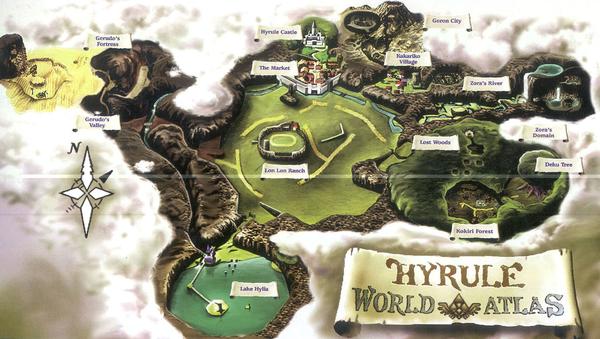
As I'm sure anyone who has investigated the timeline of the Zelda games knows, it's very convoluted. I believe the official explanation is that there are two branches of time following Ocarina of Time, one in which Link lived out his entire childhood, and one where he skipped a few years thanks to the Temple of Time. There are plenty of other issues to deal with as well, like when Vaati was active relative to Ganon, and which Link is the hero of Link's Awakening. There's even been some talk of A Link to the Past taking place AFTER the first two games, despite its title. And I really don't know much of anything about Phantom Hourglasses or Twilight Princesses. But general wisdom seems to be that Zelda II: The Adventure of Link is a direct sequel to the first game (well, duh), and LttP a prequel. OoT is, in turn, a prequel to LttP, showing the Imprisoning War that's mentioned as history in the earlier game. And with that in mind, let's take a look at the development of the Land of Hyrule from one game to another. Here are the relevant maps that I could find:

The Overworld in the original Legend of Zelda
The world of Zelda II: AoL
Map of Hyrule from the Valiant comic series (non-canonical, but pretty accurate as far as I can see)
Hyrule from LttP
Hyrule from OoT

You'll notice that the entire overworld from the first game is crammed into the southwest corner of the second, sort of like what was done in the first two Dragon Quest games. The Valiant comic map does a decent job of showing locations from both of these games in relation to each other. LttP shows essentially the same land as the first LoZ, but it's much more settled (in the Light World, anyway). The OoT map looks confusing at first, with familiar landmarks in totally different locations, but it makes more sense when viewed at an angle, with Lake Hylia in the lower right corner and the Gerudo desert in the lower left. Hyrule Castle does appear to have been moved, but maybe the King wasn't comfortable having his home so close to Death Mountain.

If we look at the maps in chronological order, it seems to show a kingdom in decline. Some of the races from OoT, like the Gorons and the Gerudo, are no longer present in LttP. It's possible they're in hiding (as the Zora seem to be) or have relocated to other lands, but the fact remains that LttP's population is much less diverse. And the first game, when viewed by this lens, looks positively post-apocalyptic. There's a large graveyard where Kakariko Village used to stand, and a lake with two islands in place of the castle. Pretty much all the people are squatting in caves trying to scam money from each other ("door repair charge," my ass). Even without all the monsters, it would be pretty bleak. AoL reveals that there are actual towns outside the limits of the first map, however, and most of them are named after sages from OoT (Rauru, Saria, Darunia, Ruto, and Nabooru). Actually, looking at it from a real-world perspective, I guess it's the sages who were named after the towns, but within the fiction the sages came first.
vovat: (zoma)
I have to admit that I've always liked Erdrick, the legendary hero in the early Dragon Quest games. The first two mention him as a figure from the past, and you play as his descendants. Then, in Dragon Warrior III, you actually play as Erdrick, although you don't find this out until the end. Apparently, "Erdrick" was retconned into a name only bestowed on great heroes by the King of Alfegard. In Japanese, the name of the hero is "Loto" (sometimes spelled "Roto"), and I've seen the suggestion that Erdrick is the guy's given name, and Loto his honorific name. I really don't know why they'd change the name so much for the English translation, but I quite like the sound of "Erdrick." It's also the name of a street in northern Philadelphia, by the way.

In the first Final Fantasy game, there's a grave in Elfland that purports to be that of Erdrick, who died in his twenties. Since DW3 starts on his sixteenth birthday, it's certainly possible that this is the same person, and even allows a few more years for extra adventures. And for that matter, "Alfegard" more or less means "Elfland." Oddly enough, I've heard that the Japanese version of this gravestone mentions not Loto, but Link. I can't help thinking of a grand battle taking place there in the distant past, in which both Erdrick and Link were killed. Since it's almost certainly not the same Link in every Zelda game (unless constant time travel and memory loss are involved), it's possible that one of them died on the Final Fantasy world, right? Actually, Captain N had episodes that took place in the worlds of all three of those game series, so maybe the show isn't as far off base as everyone thinks.

There are plenty of other cross-references in video games. Some of them can simply be considered homages (like how the magic whistle in Super Mario Bros. 3 plays the same tune as the one in the original Legend of Zelda), but there are also enemies appearing in both the Mario and Zelda series. Is this a case of parallel evolution, or a sign of travel between worlds? Link and Samus Aran both make cameos in Super Mario RPG, and the enemy Culex is probably supposed to be from the Final Fantasy universe. And while I've never played any of them, I understand that the Kingdom Hearts games have FF characters interacting with Disney cartoons, of all people. So maybe my own often-considered idea of having some video game characters visit Oz isn't as ridiculous as it might sound (although it would probably be just as cheesy).

I'm going to a concert tonight. That should be fun, but the lack of sleep won't be.
vovat: (Minotaur)
To begin with, happy birthday to [livejournal.com profile] k1cup!

Having played a fair amount of Chrono Trigger recently, I thought the time might be right to address the role of the silent protagonist in video games. Crono, who has no dialogue in the game (except apparently in one ending I haven't seen), is one of the most famous examples of this concept. This has led to some jokes about Crono being mute, but I really don't think that's the intention. Rather, he's the viewpoint character, and I think you're supposed to be filling in his lines yourself. It's part of the whole role-playing thing, you know? I understand that Crono DOES talk when he makes a ghostly cameo in Chrono Cross, although I never got to that point in the game myself.

Now, there are plenty of games where the hero doesn't talk, but it doesn't really count when no one else does either, except occasionally to inform you that their princess is in another castle. And we've heard Mario speak plenty of times since then. Interestingly enough, in Super Mario RPG (which appears to have been largely inspired by Chrono Trigger), he DOES have the silent protagonist role. I understand that the later Dragon Quest games tend to go with the silent protagonist idea, but most of the Final Fantasy ones don't. Cecil in 4, Bartz in 5, and Cloud in 7 are all main protagonists and viewpoint characters, but they all have readable dialogue. Of course, pretty much every RPG has SOME dialogue from the hero that doesn't appear on the screen. When you talk to a person, you usually only see their response, but I don't think that's supposed to indicate that you're just staring stupidly at them. It's just that seeing your lines every time would get tedious, and take up a lot of unnecessary space. (I'm reminded of the crappy Who Framed Roger Rabbit NES game, which has Eddie Valiant saying, "Can you help me?" to every person he meets.) What I think makes characters like Crono unique is that the other characters in their games all talk quite a bit, while he doesn't.

I don't know what the first game to use a silent protagonist was, but I suspect Link was one of the earlier ones. I believe it was Shigeru Miyamoto who said that the character's name came from his being the LINK between the player and the game. And even though the first Zelda game didn't have much dialogue at all (yeah, you got the occasional "Buy somethin', will ya?" and "Dodongo dislikes smoke," but not much else), I'm pretty sure they continued with the tradition of Link never actually talking (although he does yell and grunt sometimes). Yeah, he talked in the Magnavox CDI games, but those are about as canonical as the Infancy Gospel of Thomas.

And if I might share one more video-game-related link before I post this, check out this spoof where Garfield meets Final Fantasy.

April 2026

S M T W T F S
   1234
567891011
12131415161718
19202122232425
2627282930  

Syndicate

RSS Atom

Most Popular Tags

Style Credit

Expand Cut Tags

No cut tags
Page generated Apr. 15th, 2026 06:25 pm
Powered by Dreamwidth Studios