vovat: (Minotaur)

With all the writing about Final Fantasy VI I've been doing, you'd think I've actually played the game again recently, but such is not the case. It's just that one thing leads to another, and posting about Ultros and Siegfried made me think of another odd character in the game, this time a playable one who actually makes his first appearance in FF5. This is the gender-ambiguous mimic Gogo, who teaches Bartz's party the Mimic job class. The only way to defeat him (I'm going with male pronouns for the sake of convenience, even though we have no idea whether the character is male, female, or neither) is to do nothing, thus mimicking him. If you try attacking, he'll wipe out the party in a few short moves. After the fight in the sunken Walse Tower, Gogo will leave through a magic portal to the Cleft of Dimension.


In FF6, the party encounters Gogo on a small, triangular island known simply as Triangle Island. Well, to say he's "on" the island isn't quite accurate. The island is inhabited by giant worms known as Zone Eaters, which swallow people and thus send them into some kind of pocket universe.

There are a lot of traps in there, as well as green-clad guards who try to knock you off a bridge. My brother referred to the guards as leprechauns, and that stuck with me. Anyway, once you make it through the dungeon, you can recruit Gogo as a member of your party. His skill is in imitating the moves of the last player, which is basically what the Mimic class in FF5 entails.


There has been some speculation as to the identity of Gogo, some of which is discussed here. A popular theory back in the day was that he's actually Setzer's old girlfriend Darill, whose airship crashed on an island similar to the one where Gogo lives. A less popular idea is that he's Emperor Gestahl. I believe much of this speculation came from a time before FF5 had been officially released in English, so perhaps the speculators didn't know the same character had appeared in a previous game. That seems to me to make it less likely that Gogo is a character from earlier in FF6 under an assumed identity, but it's always possible that there's more than one Gogo. After all, with all that clothing, who can tell?

Personally, I'm interested to know if there's any connection between Gogo and Lady Gaga. They seem to have similar fashion sense.
vovat: (Woozy)

When Ruth Plumly Thompson took over the writing of the Oz series with The Royal Book of Oz, she immediately began adding her own creations to the already pretty full roster of recurring characters. Her first Oz book introduced not only Sir Hokus of Pokes, but also the Comfortable Camel and Doubtful Dromedary, known as Camy and Doubty for short. The two camels come from the desert domain of Samandra, one of the few parts of Oz where animals are unable to speak. While in a caravan, a sandstorm blows the two of them to the main part of Oz, where they're surprised to learn they can converse with humans. Camy takes an immediate liking to Sir Hokus, and denotes the knight as his new Karwan Bashi, a term for the leader of a caravan that I think might actually come from Persia. The personalities of the camels aren't all that deep, with Camy being a perpetual optimist and doting companion, while Doubty is a pessimist who doubts everything. The two come to live in the Emerald City, where they occasionally show up to make comments, but the next major role for one of them isn't until Yellow Knight. In this book, we learn that the Sultan of Samandra had stocked the magic dates needed to restore the kingdoms of Corumbia and Corabia in Camy's saddle sacks, and after a ten-year search his seer Chinda has discovered the camel in the Emerald City. The Sultan temporarily retrieves Camy, only to find out that the dates are gone from the sack. At the end of this story, Camy ends up settling in Corumbia with Sir Hokus, but Doubty doesn't. Wishing Horse confirms that the two of them are living in separate places, and I found it a bit odd for Thompson to break up the duo.


One oddity of John R. Neill's drawings of the two is that, as suggested here, he might not have known what a dromedary was. The term properly refers to a one-humped camel (the two-humped is a Bactrian), but it was apparently once common for people to confuse the two.

Thompson eventually brought in another camel protagonist, Humpty, in her Enchanted Island. He doesn't come from Samandra, but rather from Hah Hoh Humbad in the Munchkin Country. He was the favorite steed of the Shah of that place, but he was stolen by robbers and sold to a circus in the Outside World. David Perry finds him at the circus, and with some help from a magic wishing button that his grandmother attached to his shirt, the two of them journey to Oz. While he originally plans to return to Humbad, Humpty ends up settling with the shepherd Malacca Malloo in the Kingdom of Kapurta.
vovat: (Woozy)
When L. Frank Baum came up with his map of Oz for the endpapers of Tik-Tok of Oz, he included a few locations that he'd go on to use in later books. Whether he actually had plans for them or just threw on a few names he thought sounded good is unknown, but he labeled an area in the northwestern Gillikin Country as "Skeezer," and we finally learn who the Skeezers are in Glinda of Oz. As it turns out, the Skeezers live on an island in a lake, and Ozma becomes aware of them when their neighbors, the Flatheads, declare war on them. The reason for this is revealed during the course of the story, but can largely be traced back to the time when the Flatheads were ruled by three women known as the Adepts at Magic. They taught some of their magic to Queen Coo-ee-oh of the Skeezers, but she betrayed them by turning them into fish. One of the transformed Adepts revealed that, if any one of them died, Coo-ee-oh would lose her powers, so she kept them in the lake. One of the Flatheads took over the mountain after this transformation, calling himself the Supreme Dictator, or Su-dic for short. In order to retain his own power and lessen Coo-ee-oh's, he planned to poison the fish in the lake. The Adepts obtained the help of a Skeezer named Ervic in getting a Yookoohoo to restore their true forms, and they assisted Ozma and Glinda in restoring order. The Adepts regained their rule over Flathead Mountain; and since Coo-ee-oh had been turned into a vain and foolish diamond swan by the fish poison, the Skeezers made a friendly noblewoman named Lady Aurex as their new queen, with Ervic as his prime minister.


While that's the general story, it leaves out most of what's unusual about the two small societies, each with a population of around one hundred. As suggested by their name, the Flatheads actually have flat heads, and live on one of the infamous Ozian mountains with steep sides and a flat top. Access to other lands is accomplished by means of a staircase in the middle of the mountain. Because of their unusual heads, the Flatheads had no room for brains, so the Fairy Queen Lurline gave them canned brains that served them well enough. Once the Su-dic took power, however, he and his wife Rora began stealing brains from their enemies, giving them the extra knowledge they needed to become accomplished magicians. Coo-ee-oh removed Rora's skill in witchcraft by turning her into a golden pig, but not before she had mixed up some fish poison that apparently had additional magical properties. After ending the war, Glinda rounds out the heads of the Flatheads and places the brains inside, hence preventing any more mind-stealing. As for the Skeezers, the Queen used what she'd learned from the Adepts to make the island into a marvel of mixed mechanics and magic. Her power to expand and contract iron enabled her to submerge the entire island and restore it to the surface at will. She also constructed what might well have been the first submarines in the Land of Oz. The primitive science fiction effect of the island is augmented by the palace guards being "armed with queer weapons that seemed about half-way between pistols and guns, but were like neither," but they never have any occasion to use them during the story.


The term "Flathead" was used to refer to the Salish tribe, which was native to Montana. The rather derogatory-sounding name apparently came from the fact that, unlike their neighbors, the Salish did not practice vertical head-binding. I think it's likely that Baum just took this name and made it literal for Oz. "Skeezer" was probably just nonsense, although the term has since come to refer to crack whores, or loose women in general. I assume this doesn't have anything to do with Coo-ee-oh's reputation, but who knows? :P It might also relate to "skeezicks," an American slang term for "rascal" or "rogue" dating back to the mid-nineteenth century, as well as the name of a creepy crow-like creature from the Uncle Wiggily series (whom I remember from the Uncle Wiggily board game that I used to play a lot as a kid). There's also a character named Skeezix in the comic strip Gasoline Alley, but he wasn't introduced until a few years after Baum's death (although the strip itself did exist while Baum was still alive).
vovat: (Woozy)
In Oz, there are a few small countries with economies based on the making of clothing. The first one to feature in a book is Ragbad, in the deep southern Quadling Country near Jinxland. This kingdom is where various textiles grow, although it fell into ruin in the time of King Fumbo, who is presumably still the ruler. He was a well-read but lazy man who spent the majority of the royal treasury on books. Kind of an odd way for an author to devise for a kingdom to be ruined, but there you go. Actually, Ruth Plumly Thompson mentions Fumbo spending money on books AND TOBACCO, so maybe it's the latter that really bankrupted the monarch. Thomspon's Oz books contain a lot of smoking with no real value judgments on the subject, but perhaps Fumbo's plight is a subtle indication of how expensive the habit can be. (Quite frankly, I'm not sure how ANYONE can afford to smoke, especially nowadays.) Anyway, due to the economic collapse, nearly all of the workers, guards, and courtiers leave the kingdom. The only remaining inhabitants were the royal family (King Fumbo, his wife who goes by the nickname "Mrs. Sew-and-Sew," and their son Prince Tatters), twenty-seven families (reportedly about one hundredth of the original population), the wise man Pudge, the footman Scroggles, and the soldier Grampa. Oddly, Grampa isn't actually a grandfather, and it's never explicitly stated whether "Grampa" is a given name or a nickname. I suppose anything is possible in Oz. Anyway, when King Fumbo's head blows off in a storm, it's Grampa who accompanies Tatters in trying to find it, and his name (such as it is) that features in the book's title. Without giving too much away, I'll reveal that Tatters' new father-in-law provides Ragbad with a fortune, and the kingdom's prosperity is restored. Given what we're told in The Emerald City of Oz about the Ozian economy, I'm not sure how one of its kingdoms could become so destitute, but Thompson wasn't always one for following the rules when they interfered with the stories she wanted to tell.


The very next book, The Lost King of Oz, begins in a small Gillikin kingdom called Kimbaloo. Here, the main crop is buttons, which grow on trees. The rulers are King Kinda Jolly and Queen Rosa Merry, and their subjects 250 boys and 250 girls. The boys sell buttons for the king, while the girls sell bouquets from the queen's bouquet bush. While there might well be more children in Oz who hold down jobs than there are in the United States (hey, Ozma herself is a perpetual teenager), it still strikes me as kind of odd that there would be this many children living in a small kingdom with no parents. Are they orphans? We don't really know. While Kinda and Rosa are quite friendly, I doubt they really fill a parental role for 500 kids. And this story is centered around finding Ozma's long-lost father, who also becomes sort of a surrogate father to Snip, a button boy who leaves Kimbaloo when he accidentally stumbles on Mombi's evil plot. King Kinda, not realizing Mombi's past as a wicked witch, had hired her as the castle cook. When the witch leaves the kingdom with Snip and Pajuka, the royal bodyguard General Whiffenpuff goes in search of an invisible cook who lives near the Emerald City.


Finally, Gnome King introduces Patch, identified as the seven hundred fifth small country in Oz, although the order in which these places are organized is unclear. Patch is in the Winkie Country, but doesn't follow the typical yellow color scheme, instead laid out as a patchwork of many different colors. The people, known as Quilties, make patchwork quilts and mend clothing. Because of how hard they work, the Quilties tend to have cross attitudes, and they're prone to falling into pieces. As the country is in Oz, they don't die when this happens, but instead are swept into a scrap bag and left there for about ten years, after which they come back to life. The king or queen actually works harder than anyone else, and goes to pieces more quickly than any of the other Quilties. Rulers are chosen by the golden Royal Spool of Succession, which unravels to point out the next king or queen. As the story begins, the Prime Piecer and Chief Scrapper of the realm (who appear to be its actual leaders) follow the thread to the Emerald City and take the Patchwork Girl to be their queen. She is excited about this at first, but upon learning how much work it is, she escapes in the company of Peter Brown and the former queen's pet bear Grumpy. The Wizard of Oz eventually finds that the person actually indicated by the thread is actually a palace mender named Susan Smiggs. Ozma promises to reform the laws of Patch in order to make being queen less of an ordeal for Susan than it was for Scraps, but we never find out exactly what happens in that respect. Patch is actually another kingdom that Thompson introduced in another story before bringing it into Oz, the tale in question being called "Land O' Patch." According to this story, Patch is located in between the witch and fairy countries, and its king at the time (possibly the original ruler) is half witch and half fairy.
vovat: (Woozy)

Since I did a bit of discussion on sea monsters on Saturday, I might as well continue the theme in this Oz post by writing a bit about Quiberon from The Giant Horse of Oz. This sea monster, who shares his name with a peninsula in western France, was placed by Mombi in Lake Orizon to cut the Ozure Isles off from the mainland. Who's Who in Oz claims that she produced him from her closet. He's described as having "the head scales and talons of a dragon and the long hideous body of a giant fear-fish." At another point in the book, however, he's described as a fear-fish himself. It's never stated exactly what a fear-fish is, but Neill draws the monster with a rather serpentine body. He also has a lock of hair between his horns. Quiberon breathes smoke and fire, and can write in the sky with his smoke, but is capable of speaking in the more usual fashion. When the monster lived in Lake Orizon, he ate the giant sea horses on which the Ozurians had ridden, and kept the people as servants. Eventually, the Wizard of Oz learned about Quiberon, and used magic to petrify the monster.


Some much more pleasant Ozian water dwellers are the Scooters from Lost King, who live on the surface of the Gillikin River. They have ski-like devices attached to their feet and sails on their backs, which enable them to scoot along the water. They tend to be tall, and have moss for hair, which they cover with waterproof hats. When young, they're known as Scoots, and only become full-fledged Scooters when their sails grow. The Scooters are generally friendly and playful, and eat raw fish.
vovat: (Woozy)
Since it sometimes seems like you can find an Ozian community dedicated to just about anything, it shouldn't come as any surprise that there are a few centered around cleaning. One of these is Monday Mountain, a blue mountain located in the normally yellow Winkie Country, inhabited by washerwomen known as the Tubbies. True to their name, they tend to be overweight. They're ruled by a queen, who has a daughter named Pearl Borax. The Tubbies spend most of their time in washing clothes, and all of their dinner consist of potatoes and cabbage. Live clothes horses can be found on the mountain, and a running fence prevents intrusion or escape. Dorothy and Percy Vere were imprisoned there for a few days during Grampa in Oz, and the mountain was reused for an Oziana story called "Adventures on Monday Mountain."


The next place on the list is Suds, a city where the buildings and people are all made of soap. Peter Brown and Scraps visit this place in The Gnome King of Oz, and they encounter people also known as Suds, who dress in robes and turbans of Turkish toweling. This material grows on trees, and Suds is also home to rubber shower trees and soap bubble bushes.

The ruler is a sultan named Shampoozle, who is made of green soap.

This might actually be one of the few themed towns to receive two visits in canonical books, as Lucky Bucky has Bucky and Davy Jones encounter a place made of soap. They don't encounter Shampoozle and his turbaned subjects, however, but instead a man named Slippery Dick. While I'm sure modern children would have a field day with that name, it's actually a play on the name of a kind of fish. Dick lives in a castle made of Castile soap, and Davy's map identifies the area as "Slippery Dick's Land," so presumably he's a ruler of some sort. Is he a sub-ruler under Shampoozle, or the leader of another soapy community? The Haff/Martin map identifies this place with Suds, and since they're both in the Winkie Country, they're probably both the same, or at least adjacent. While there, Davy becomes totally submerged in a blizzard of talcum powder.


Finally, we come to Cleanitupia, a small area located just in front of the land of Pristinia. As everyone entering Pristinia must be as clean as possible, Cleanitupia and the Bathasphere are used to thoroughly wash any visitors. This job is partially accomplished by a group of sponge-like creatures with brushes on the ends of their legs. Pristinia itself probably isn't worth visiting, as it doesn't appear to have any inhabitants, just a disembodied voice that tells everyone to keep off the grass and otherwise not disturb anything.
vovat: (Woozy)

We move on from chickens to foxes, turning to the city of Foxville, introduced in The Road to Oz. And discussing Foxville pretty much necessitates also delving into its neighboring city, Dunkiton. These two towns are also located outside of Oz, south of the Great Sandy Waste, but they still have talking animals. Foxville is a quite beautiful and cultured city, full of marble buildings decorated with images of fowl, and with its own theater. The foxes who inhabit the city walk upright, dress in fancy clothes, and are apparently about the size of humans. Their ruler is the bespectacled King Renard IV, who claims that his name is pronounced "with the accent on the 'ren,'" although it seems to me like its derivation from French would suggest otherwise. His private name is Dox, and it's this that his friends usually call him. The Fox King was so impressed by Button-Bright's youthful curiosity and unassuming manner that he magically gave the boy a fox head, which he only managed to change it back by bathing in the Truth Pond.


Thinking of Foxville in combination with this April Fool's joke mentioning Megan Fox playing Dorothy made me think that, if she plays any Oz role (and I'd rather she didn't play any role at all; seriously, what's her appeal?), it should be one of King Dox's daughters. Then again, any new movie would probably make the foxes CGI, so I guess she wouldn't be recognizable. Maybe I should just slip a quick pop culture reference into one of my own stories, with the King having a daughter named Megan who's absurdly skinny. Maybe she's on a no-poultry diet. :P


Anyway, moving on to Dunkiton, it's a much less impressive-looking city than its neighbor. It's made up of low, square houses of whitewashed brick, scattered all over the town. The donkey inhabitants insist that they're intelligent enough not to need an organized city. The donkeys claim to be the smartest creatures in the world, but it's clear that they're somewhat deluded as to how intelligence actually works. They don't attend school because they say they're born wise, so the children are kept occupied in whitewashing the walls. While they do have the ability to read and write, they're not very good at it. Still, they've done pretty well for themselves given their limitations, being able to use their hooves for various tasks that might usually require hands. Unlike the foxes, the only clothes they wear are hats and leg jewelry. The king of the city, Kik-a-bray, seems to be a more accomplished magician than King Dox, using his jeweled staff to make food, among other things. The Donkey King was just as impressed by the Shaggy Man as the Fox King was by Button-Bright, so he followed in Puck's footsteps in giving Shaggy a donkey head.


Ozma invites both of the monarchs to her birthday party, and while their cities are traditional enemies, the kings actually end up getting along very well. Whether or not this leads to improved relations between the foxes and donkeys isn't discussed.
vovat: (xtc)

As it's Easter Monday, I thought I might gear my Oz post toward a kind of animal associated with Easter. Not bunnies this time, although there are certainly a lot of them in the series, but chickens. L. Frank Baum had experience raising chickens, and his first published book was on that subject. So it's not too surprising he'd bring a chicken into the Oz series, which he did with Billina in Ozma of Oz. While the movie Return to Oz makes Billina a hen from Dorothy's Kansas farm, the book doesn't have the two of them meet until Dorothy falls off a ship to Australia (how Uncle Henry can afford this trip, I don't know, but he's taking it anyway) in a chicken coop, which turns out to already be occupied by the yellow hen. The coop washes ashore in the Land of Ev, and the hen can talk there, even though a later reference by Nanda suggests that native Evian chickens can't. The foul tells Dorothy that she grew up on a farm, and one of the boys there named her Bill, thinking she was male. When it turned out she was female, the name stuck, but Dorothy decided to feminize it by changing it to Billina. The hen is more or less the hero of the story, as she's the one who overhears the Nome King confessing his tricks to his Chief Steward, and hence is able to save the royal family of Ev and the Ozites who were transformed trying to save the same royals. Also, the Nomes turn out to be terrified of eggs, which fact the Scarecrow and Dorothy use to create a distraction with Billina's eggs and take Roquat's Magic Belt.


Billina decides to take up residence in Oz, where she starts her own colony of chickens. Oddly, there are a few references to her being the ONLY chicken in Oz, despite the fact that Wizard has Dorothy waking up in the Emerald City to the sound of a crowing rooster and cackling hen. There's also the question as to who fertilized the eggs if there were no other chickens, although I've seen some readers propose that the father might be the red rooster in Ev who was fighting with Billina during her stay there. Billina names all of her children Dorothy in honor of the girl who brought her Oz, but once she realizes that some of them are male, she changes their names to Daniel.

Ruth Plumly Thompson, who usually wasn't much for sticking to Baum's pronouncements that certain animals were practically unknown in Oz (and I'm not sure we can blame her, since Baum contradicted himself in this respect as well), frequently mentioned chickens in various Ozian communities. She also occasionally had humans eating chicken, despite the fact that Emerald City had Dorothy insisting that Billina was so honored in Oz that the people wouldn't think of such a thing. We don't know for sure that this taboo existed in outlying communities, however, and it's also possible that someone devised a way to grow chicken (or at least a very similar-tasting substance) on trees. But the subject of meat-eating in a country where animals are supposed to all talk and never die is a tricky one no matter how you look at it, and I've already addressed it in other posts anyway.

While I'm not going to make a list of all the chickens mentioned in the series, I will mention the brick-laying yellow hen from Perhaps City, as well as the fact that the McGraws' Rundelstone refers to Gillikin chickens as Gillicocks and Gillihens.
vovat: (Woozy)

A theme we see every once in a while in the Oz series is that of people in packages. The first example of this (that I can think of, anyway) occurs in The Cowardly Lion of Oz, with the city known as the Preservatory. The people there live in jars and cans, being preserved through jellying, pickling, and other such methods. They insist that they'll spoil without their jars, despite the fact that no one grows older in Oz anyway. It seems to me that it's basically a cult. The Preserves have a queen, the jellied Preserva the Great, but their true leader is the Imperial Squawmos. This Cookywitch, although not in a jar herself, is the one responsible for preserving all of the others. In keeping with the general theme, the buildings in the Preservatory are basically giant cabinets with shelves.


A similar idea can be seen in the Box Wood, part of the great forests that take up most of the western part of the Kingdom of Ix, and is itself surrounded by a giant box. The people are known as Boxers (an obvious pun anyway, but possibly also a reference to the Boxer Rebellion in China), and dress in boxes to keep themselves from spoiling. Fortunately for them, boxes grow on trees in their wood. Many of them contain useful items, but the Boxers usually just throw them away. They're horrified to learn that it works the other way 'round in the rest of the world. The leader of the Boxers of Ix is a chief named Chillywalla. A Boxer also shows up in the Emerald City in Wonder City, but this one is identified as a Quadling. Whether he's related to the Boxers in Ix isn't specified. Jenny Jump provides him with a shiny new cellophane suit, and he lands a job as Head Waiter at the Great Crystal Banquet Hall.


A different variety of packaged people can be found in Tidy Town in the Winkie Country. These people are made from powdered mixes, and spend all their time performing their designated jobs. The man behind this town is Max the Mix-Master, who used to be the King of Hotchinpotch, but grew fed up with the contrary and disorganized behavior of his subjects. So he left his domain and found an abandoned cabin that had belonged to an as-yet-unidentified magician, which contained the equipment he needed to create his organized new town and its people. All of the artificial people are men, as Max considers women and children to be nuisances.
vovat: (Woozy)

One of several small Ozian communities that Dorothy and her companions visit during the course of The Emerald City of Oz is the Quadling town of Fuddlecumjig. I remember writing this on a list of Ozian places while in high school, and some of my classmates found it amusing, presumably because of the "cum" part. Of course, the dirty meaning for "cum" is pretty recent, at least as far as I know. In Baum's time, it seems to have just been a nonsense syllable. Anyway, Fuddlecumjig is home to the Fuddles, who are essentially living jigsaw puzzles. They fall apart at the slightest provocation, and have to be put back together. Fortunately, Fuddlecumjig has become somewhat of a tourist attraction, with people from all over Oz showing up to reassemble the Fuddles.

The town leader of Fuddlecumjig is Larry, the Lord High Chigglewitz, a bald man who walks with a limp because a piece of his knee was never found. Another important Fuddle is Grandmother Gnit, an old lady who spends much of her time knitting mittens for a kangaroo who lives just outside town. You might wonder why a kangaroo would need mittens, but she insists that without them her hands would get sunburned, and she'd catch cold. March Laumer makes this kangaroo in a more developed character in his Careless Kangaroo, naming her Marguerite Supial (Mar for short) and giving her several children. As for Grandmother Gnit herself, Jim Vander Noot's short story "Button-Bright and the Knit-Wits of Oz" has the boy meeting Grandpa Gnit, who explains that he and his wife were rulers of the knitting-based Quadling community known as Knit-Wits until she started falling to pieces and had to be sent away. This is an interesting idea, as it suggests that ordinary Ozites can occasionally turn into Fuddles. So is Fuddlecumjig like a fairyland leper colony? Well, maybe in some ways, but I don't know that Fuddlism is contagious.


I'm sure the arbiters of good taste will be glad that there's no indication that people have to assemble the Fuddles' internal organs, just their outsides. So are they hollow inside? That isn't what I think Baum indicates, as the Fuddles do eat. All I can figure is that, when their outsides are reassembled, the insides follow suit. Careless Kangaroo seems to support this, as when Grandmother Gnit loses her topknot, part of her brain goes along with it.
vovat: (Kabumpo)
While giants like Mr. Yoop could reasonably be referred to as ogres, I'm not sure the word is ever used to describe them. There is, however, one minor but plot-significant character in Pirates in Oz who is specifically called an ogre. That's Og, the Ogre of Ogowon, whom Peter Brown releases from his enchanted prison by breaking an egg in a nest at the top of Mount Up. It turns out that Og had been trapped inside the mountain for 500 years due to a spell cast by a witch on the next island over, who thought the ogre snored too loudly. He helps Peter by blowing the becalmed Crescent Moon to the shore of Menankypoo, and claims that he'll escape the mountain by breaking through it. The mountain is the home of the Cascadians, people made of water who spend their time sliding down the side and then spraying themselves back up in a fountain, and it's not known what happened to them when Og broke out of the mountain. I assume they survive, but do they end up merging with the waters of the Nonestic Ocean, or what?

In a later story, actually the first chapter of her book King Kojo, Thompson reintroduces the Ogre of Oh-Go-Wan. But is this the same ogre, or a different one? Since the ogre in that story dissolves in salt water, it's unlikely that he would have lived on an island in the ocean. There's no reason why Og couldn't have also lived in Kojo's Kingdom of Oh-Go-Wan at one point, though. While he identifies himself as the Ogre of Ogowon, there's no indication that this is the name of the island where he lives, and a flag calls it Mount Up. So perhaps there's a connection between the ogres, but they're probably two different characters.

I'm also going to address trolls in Oz, but I don't believe there are any in the Famous Forty. Canonical authors Eloise and Lauren McGraw do, however, introduce a troll in their Forbidden Fountain. He's a Toll Troll, who lives at a bridge and demands that anyone crossing it pay him in honey. Trolls are also quite significant to the plot of Eric Shanower's graphic novel Forgotten Forest. His trolls, who dwell in a volcano near the Forest of Burzee, are nasty, but hardly ogrish brutes. In fact, they're notorious schemers, with their king having a long-term plan to seduce a wood-nymph named Nelanthe and use her to help destroy Burzee.
vovat: (Woozy)
Considering all the odd and fantastic creatures that turn up in Oz, it's not too surprising that there would be some giants, is it? There are a few in the Baum books, and a LOT in Thompson's additions to the series. Here are some of the more notable appearances of giants in the Oz books:

  • First of all, the Yoops, perhaps the most famous giants in Oz. In The Patchwork Girl of Oz, Ojo's party comes across the cage of Mr. Yoop, advertised as the largest untamed giant in captivity. According to his identification card, he's twenty-one feet tall, weighs 1640 pounds, and has the typical ogrish habit of eating human flesh, which he prefers with orange marmalade. Even though he's caged, he still poses a threat to passersby, as the corridor in front of his prison is narrow, and he can reach pretty far. In Tin Woodman, the protagonists come across Yoop Castle in the Gillikin Country, and assume it's unoccupied. As it turns out, though, it's still the home of Mrs. Yoop, giantess and expert in transformations.

  • The giant slaves of the super-strong people of Herku.
  • Crinklink, a giant ferryman with the ability to change size and talking jacket buttons. He imprisons Dorothy, but later reveals himself to be the Wizard trying to teach her a lesson.

  • The giant subjects of King Terribus of Spor, on the Enchanted Island of Yew. Considering that the Red Rogue grew to be bigger than any giant, yet he could still walk around a castle built for humans, I have to suspect that these giants aren't quite as big as the Yoops. Still, they're feared fighters.
  • The inhabitants of the Giants' Peak, who have an unusual arrangement of eyes, with one in the forehead and one in the back of the head. They feature in the story "The Littlest Giant," which is really only linked to Oz by its subtitle "An Oz Story" and a brief reference to the Gillikins. It's suspected that Baum might have added these bits in as marketing tools. I'm currently reading Chris Dulabone's The Giant King of Oz, which better ties in the Giants' Peak with the Oz series, and also features Mr. Yoop as commander of the giants' army.
  • Bangladore, the Candy Giant, who's addressed in this post.
  • Ruggedo, the former Nome King, who's normally pretty small but used Glegg's Instantaneous Expanding Extract to turn himself into a giant three-quarters of a mile tall during Kabumpo. In this form, he ran away to Ev with Ozma's palace stuck on his head. In the same book, Tik-Tok mentions a three-legged giant living in Ev.

  • Crunch, a stone man three times the size of an ordinary person, animated by the wizard Wam and later de-animated by Glinda and the Wizard of Oz.

  • The Big Wigs of Immense City in Ev, who are only giants while they wear their wigs. See this post for more details.

  • Nandywog, who was kicked out of the giants' colony on Big Top Mountain for never growing to be more than twenty feet tall. He settled in the triangular Gillikin valley of Tripedalia, where all the people and animals have three legs each. The Tripedalians are willing to accede to Nandywog's every request, but they're afraid of him, and the giant longs for companionship. When Randy and Kabumpo visit in Purple Prince, they befriend Nandywog, although the elephant is secretly jealous of pretty much everyone bigger than he is. Is Big Top Mountain the same as the Giants' Peak? Probably not, as there's no indication that Nandywog has the peculiar eye arrangement of those giants. Melody Grandy has indicated, however, that she thinks of her Huge Mountain as the same place as Big Top, only with a different name to stave off copyright issues. Her own giant protagonist, Orlando, becomes king of this mountain.
  • Loxo the Lucky, a giant who seems to be about the same size as his home of Big Enough Mountain, and possesses a magic magnet that will attract anything he desires. When King Sizzeroo accidentally runs Umbrella Island into his head in Speedy, Loxo demands restitution in the form of a boot-lacer, as he finds this task difficult to perform himself. The wizard Waddy tricks him into eating a sponge cake that shrinks him down to normal human size, but he's apparently satisfied with this. According to a Fred Otto short story in Oziana, he settles down to become a farmer in Grapelandia. The Umbrellians read about Loxo in the Encyclopedia of Giants, which is a book I wouldn't mind seeing.

  • Snorpus the Mighty, whom the Wizard of Wutz employed to guard the entrance to the Silver Mountain. Snorpus has only one eye, which rotates between four eyeholes. When Handy Mandy tricks him into letting her into Wutz's lair, the wizard reduces him in size and plants him in a flowerpot, apparently a common punishment in Wutz's domain.
  • Terp the Terrible, who grows to giant size by eating from the magic muffin tree in the Hidden Valley, and then sets a monstrous guardian at the tree to make sure no one else eats the muffins. The Tin Woodman cuts down the tree, and his companions trick Terp into the smokestack of his jam factory, where he presumably shrinks back down to human size.
  • Badmannah the Terrible, a rather uncouth black-bearded cave-dweller on Upandup Mountain in the Gillikin Country. Like Loxo, he also has a magical tool, in his case a drag net. Unlike the fairly sedentary Loxo, however, Badmannah uses his net to steal castles, which he then despoils of their treasures, keeping their princesses as slaves. Jinnicky deals with him by commanding his own drag net to send him to the middle of the Nonestic Ocean.
  • The gypsy giants who are passing through the Winkie Country at the time of Enchanted Island. One of them, Jerry, tries to keep the camel Humpty as a plaything. Giants apparently pass through the area often enough for Nick Chopper to employ a watchman named Ben Tover to look out for them.
vovat: (Woozy)

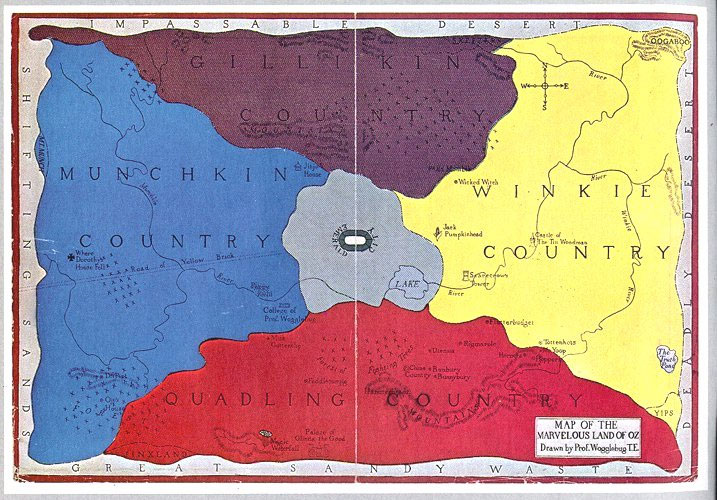
While we're talking about Ozian mountaintops communities, why don't we take a look at Mount Munch, a mountain with steep sides a saucer-shaped top in the northeastern Munchkin Country, bordering on the Deadly Desert. The mountain first shows up on the map on the Tik-Tok of Oz endpapers, and first enters into a plot in The Tin Woodman of Oz. Near its foot lies the home of Nick Chopper's former lover Nimmie Amee and her husband Chopfyt, and the nearby plains are the location of the Swynes' farm. These pigs, Professor Grunter and his wife Squealina, are the parents of the Nine Tiny Piglets that the Wizard of Oz uses in his tricks. And in the next book, Magic, we learn what's on top of Mount Munch. Not surprisingly, it's an isolated civilization, the people being known as Hyups.


We only learn the names of three Hyups in the book, and they are all from the same family, the Arus. Bini Aru used to be a sorcerer, and came up with a way to perform any transformation just by saying a single word. Baum apparently spelled the word a few different ways in his first draft of the text, but it was spelled PYRZQXGL in the published version. It's important to pronounce it just the right way, however, and of course Baum never tells us what that pronunciation is. When Ozma outlawed magic, Bini destroyed all of his tools, but considered the word too good to give up. So he wrote it and the correct pronunciation on a floorboard. When Bini and his wife Mopsi, known for baking huckleberry pies, were away at a festival, their sullen teenage son Kiki (yeah, I know that's not usually a boy's name, but it apparently is among the Hyups) discovers the floorboard, and uses the transformation word to visit some of the countries surrounding Oz. In Ev, he runs into Ruggedo, the former Nome King, who convinces him to help out in his latest plan for the conquest of Oz. Kiki doesn't trust the Nome, for good reason, but he does go along with Ruggedo's scheme. They argue, however, and the Wizard of Oz learns the magic word and turns the two conspirators into nuts. When he restores them, he has them drink of the Water of Oblivion, and that's the last we see of the boy in the canon. We can only imagine how the elder Arus reacted to their missing son.


Actually, that idea forms the background for the plot of the short story "Much Ado About Kiki Aru," which appeared in the 1986 Oziana. In the story, Bini goes out to search for Kiki, and eventually finds him and brings him back to Mount Munch. The same tale also gives the origins of the magic word, and it stops working by the end. That would explain why the Wizard never uses it in later books, even when it would come in handy. On the other hand, the apocryphal Invisible Inzi, Glass Cat, and Unknown Witches all have the word still working.
vovat: (Woozy)

When L. Frank Baum first devised his map of Oz for the endpapers of Tik-Tok of Oz, he included a few places that had yet to be mentioned in the actual texts. Whether or not he had plots in mind for them when making the map isn't clear, but he would go on to use them in future stories. One of these places is the mountain of the Yips, located in the southwestern corner of the Winkie Country. The mountain and its inhabitants became significant a few books later, in The Lost Princess of Oz. When Ugu the Shoemaker stole the most valuable magic from Ozma, Glinda, and the Wizard of Oz, he also stole a gold dishpan from a Yip named Cayke the Cookie Cook.


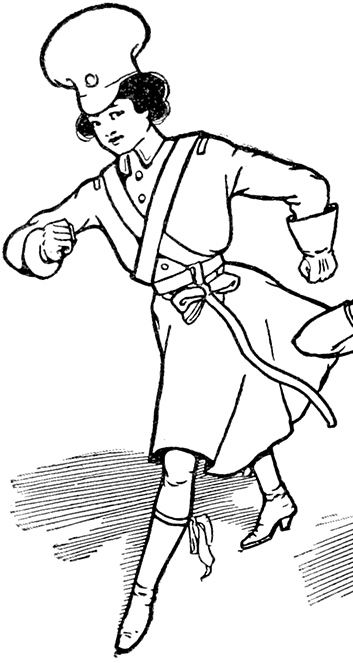
Like some other isolated Ozian communities, the Yip Country is very difficult to reach. It's located on a tableland on top of the mountain, and there are no paths leading up to it. The Yips' homes are scattered all over the mountaintop, not laid out according to any particular pattern, but simply wherever the inhabitants prefer. Also located somewhere on the mountain is the pond where the magic skosh that enlarged the Frogman grows, although none of the Yips seem to be aware of this. Baum writes that the Yips have "queer ways and notions of their own," but doesn't really elaborate. Neill, however, shows them as having rather interesting choices in hat decoration:


The only Yip who's really differentiated from the rest is Cayke herself, who leaves the mountain in the company of the Frogman to seek her lost dishpan. This dishpan, which is studded with diamonds, was passed down from mother to daughter through the generations. Cayke is aware that possessing it somehow enables her to be a better cook, but is initially unaware of its powers of transportation, which is why Ugu steals it. As John Bell mentions in a recent blog entry, Cayke herself is described as "dried up" by Baum, but Neill draws her as a young woman. While Lost Princess is the only canonical book to give Cayke a role, she does have a major part in March Laumer's Magic Mirror, in which she dates Till Orangespiegel for a while. Laumer gives her full name as "Cayke L. Baque," but I figure "Cayke the Cookie Cook" is a good enough name. Honestly, I don't see why a small, isolated population like the Yips would have adopted the custom of surnames. Then again, as we'll see in my next Oz post, the similarly isolated Hyups apparently have.

Woot!

Mar. 9th, 2010 12:55 pm
vovat: (Polychrome)

According to Urban Dictionary, the obnoxious modern interjection "woot" derives from the world of role-playing games. Long before that, however, it was the name of an Ozian wanderer. His only canonical role is in The Tin Woodman of Oz, and Jack Snow (I believe it was him, anyway) once proposed that the name could have come from rearranging the initials of the book's title (leaving out "the," of course). I'm sure we'll never know if this is true.


Woot is a Gillikin boy, whose original home was near Oogaboo, in the far northwest of Oz. His hometown was happy and content, so seeking more excitement, he decided to wander throughout Oz. In the course of his wanderings, he came upon the Tin Castle, and accompanied the Tin Woodman and Scarecrow on a journey to find Nick Chopper's old lover, Nimmie Amee. He spends a significant portion of this journey in the form of a green monkey, until Ozma transferred that form to its perpetrator, the giantess Mrs. Yoop.


Woot is a quite polite boy, usually providing the voice for NOT barging in on any strange community or dwelling the party comes across. As he remains wandering at the end of the tale, he certainly has potential to appear in more stories, but creating conflict would probably require teaming him up with other characters.
vovat: (Woozy)

Button-Bright is introduced in The Road to Oz as a boy Dorothy and the Shaggy Man meet along the enchanted road from Kansas to fairyland, who's dressed in sailor clothes and "seemed two or three years younger than Dorothy." Really, though, I think he's younger than that, as Dorothy is probably nine or ten at this point, while Button-Bright comes across as being only around four or five. He doesn't know his real name, but says that his mother calls him "Button-Bright" because his father says he's bright as a button. He also doesn't know where he lives, how he came to appear on the enchanted road, or just about anything else. At the end of the story, the Wizard of Oz and Santa Claus send him home in a bubble, but that's not the end of his tale. He reappears in Sky Island, pretty much just as carefree as in Road, but much more competent and intelligent. He tells Trot that his full name (or at least as much of it as he can remember) is Saladin Paracelsus de Lambertine Evagne von Smith, and that his home is in Philadelphia. I remember seeing it suggested that this choice might not have been entirely random, as sailor suits for children were in fashion there at around the time Baum wrote. The boy travels across the country and then to Sky Island by means of a magic umbrella that had been in his family for generations. While his father regards it as a good-luck talisman, there's no indication as to whether he's aware of its powers. He uses the same umbrella to reach the Land of Mo in Scarecrow, but he loses it, and travels with his old companions Trot and Cap'n Bill to Oz to live. While his character trait of constantly getting lost is hinted at in his earlier appearances, this is the first book to spell it out. This habit can be obnoxious when he's on an important journey and unknowingly wanders in danger, but it can sometimes come in handy, as when he's the one to discover the enchanted peach in Lost Princess.


Button-Bright is a fun character to work with, as his easy-going nature makes him fit easily into just about any situation. On the other hand, this also makes him difficult to use as a protagonist. With the exception of Sky Island, which gives all three American visitors to the skyland chances to do something heroic, he's usually a supporting character. Baum reports that he's good friends with Ojo, a Munchkin boy of about the same age. What age would that be? Well, Ojo is referred to as a "boy of ten" in Ojo, and Button-Bright is said to be younger than Trot, who is also ten. I would guess that Button-Bright must be around eight or nine by the time he settles in Oz, but it's not entirely clear. He's clearly a good bit older than he is in Road, but not by as many years as there were between the publication of Road and Scarecrow. Indeed, Button-Bright's age is one of the main reasons why some of us who are interested in when the books took place think that the first nine must be squeezed into a relatively short period of time.


Thompson never used Button-Bright in a significant role, although she did mention in Cowardly Lion that he became good friends with Bob Up, who's also from Philadelphia and also had visited an island in the sky. While Snow does give the character a few cameo appearances, it's up to apocryphal authors to bring him back in a significant way. Harry Mongold gave him his own adventure in Button-Bright, which centers around the magician Trickolas Om fooling him into looking for a magic mirror. In Paul Dana's Lost Boy, Button-Bright is revealed to be the child of a native Ozite, with the parents he mentioned in previous books having adopted him. Considering how little we know about the boy, this is possible, but it's sort of a departure from what else we've learned about him. Not surprisingly, March Laumer has his own elaborate story for Button-Bright, claiming that he fell into a treacle well and grew up, because he was unable to perform the anti-aging mantra. [1] He returns to the United States for a while, before making his way back to the Nonestic world and marrying Glinda. Yeah, I DO think Laumer often liked to pair up the least likely characters. Why do you ask? {g} The thing is, I don't find the grown Button-Bright all that interesting. In general, I prefer that characters introduced by Baum as children remain that way, as he seemed to intend. If you want to show a character in Oz growing up, take a tip from Thompson and make up your own. Still, there's certainly potential in a story about, say, Dorothy growing up. But Button-Bright? The traits that make him the most interesting are ones that he'd likely grow out of, and if he didn't his friends would get progressively more annoyed at them. In other words, would an adult Button-Bright really BE the Button-Bright we've come to know and love?


[1] The anti-aging mantra is another Laumerian idea I could never really accept. Thompson introduces the possibility of Ozites aging if they choose to (as opposed to Baum in Tin Woodman, who reports that even babies never get any older), but makes it seem as if NOT aging is the default. Therefore, Button-Bright presumably wouldn't, and perhaps couldn't, have aged at all while trapped in the well. That's just my take on the situation, though, which is obviously different from Laumer's.
vovat: (Woozy)

One character L. Frank Baum seemed to really enjoy writing was the Shaggy Man, a homeless tramp from the United States who had spent years wandering. He apparently moved around quite a bit, too, as The Emerald City of Oz has him mention visiting Mexico and Boston, yet we first see him in Kansas. In The Road to Oz, he comes to Dorothy's farm to ask which is the road to Butterfield, presumably the nearest town, so he wouldn't accidentally go there. He claims that the reason for this is that someone in town owes him fifteen cents and he doesn't want to collect it, but he later reveals that he stole a talisman called the Love Magnet from a girl there. As getting mixed up with Dorothy pretty much always results in adventures, it should come as no surprise that Shaggy and the Kansas girl ended up in a fairyland near Oz. Shaggy takes the odd events that transpire with an easy-going attitude, even when the King of Dunkiton gives him a donkey head. He also finds a way out of some of the more difficult situations, like when his baseball skills enable him to catch and dispose of the Scoodlers' heads. When he reaches Oz, Ozma offers him a home there, despite knowing that he stole the Love Magnet and then lied about it. Then again, the last American man she'd offered a home in Oz was the Wizard, who had conned the entire country for years. While I think it's foolish to read too many Christian themes into Oz (it's not Narnia, after all), I can't help thinking that repentant sinners like those two are people Jesus would have loved. Anyway, when Shaggy comes to live in Oz, it's definitely a change in his fortunes, yet his basic personality doesn't change. He still spends most of his time wandering, and while he wears much nicer clothes, they're still shaggy. His official job, according to the next book, is Keeper of the Royal Storehouses, but as Emerald City is the only book that really says anything about these storehouses, nothing comes of this later on in the series.


One thing I find interesting about Shaggy is that, after introducing him, Baum seemed eager to give him a significant role in every Oz book for a while. In Emerald City, he's part of the retinue that accompanies Dorothy and her aunt and uncle on their tour of Oz. In Patchwork Girl, he rescues Ojo and his friends from the man-eating plants, and then leads them to the Emerald City. As for Tik-Tok, while it's a little difficult to determine who the main character is, I think there's a good case that can be made for Shaggy filling this role. The story centers around his search for his lost brother, who's a prisoner of the Nome King. After that, however, Shaggy is given only minor roles, as if Baum realized he'd been overusing the character. Ruth Plumly Thompson never featured him at all, although she gave him a brief mention when recapping the plot of Tik-Tok in Kabumpo. As for John R. Neill, Shaggy MIGHT have been the "elderly man in scraggly clothes" who helps Tik-Tok with his painting, but it isn't entirely clear. Jack Snow, however, finally gives Shaggy his own book, in which he seeks out the Love Magnet's creator to have the talisman prepared, and ends up journeying back to Oz in the company of the American twins Twink and Tom.


An oddity of the Shaggy Man is that he's never officially given a name. Road refers to him simply as "the shaggy man," and later books capitalize this phrase and treat it as if it's his name. Even March Laumer, who gave names to a lot of established characters who didn't have them yet, refused to come up with one for Shaggy. In fact, I think the only book that does name him is Karyl Carlson and Eric Gjovaag's Queen Ann, in which he reveals to Ozma that his name really IS Shaggy, or, more accurately, Shagrick Mann. Shaggy's brother is even more mysterious. Tik-Tok reveals that he was a miner in Colorado before being kidnapped by the Nome King, who placed an enchantment of ugliness on him. Because of this, he's sometimes referred to as the Ugly One, but since that enchantment is broken before the end of the book, it's no longer accurate. Even though he comes to Oz to live with his brother, he's never given a major role after that, and the brief references he does receive simply call him "the Shaggy Man's brother." I've heard that the play on which Tik-Tok is based refers to the brother as "Wiggy," which is presumably a nickname, but still better than nothing. I've seen a few apocryphal books that named the character Ichabod, and Mark Haas's Emerald Mountain calls him Daniel. I've also seen it suggested (by Aaron Adelman, I think) that "Wiggy" could be short for William.


Before I close out this post, I feel I should mention Laumer's take on the character, which is that he's secretly in love with Dorothy. That's why he shows up at her farm in Road, and while they become close friends, he's too conscientious to ever actually do anything about it. This is an interesting interpretation, and a good lesson in this era of To Catch a Predator that not all pedophiles act on their urges (it's a mental illness, not a crime), but not how I prefer to see Shaggy. To me, he gets on so well with children because he's still childish himself in many ways.
vovat: (Polychrome)

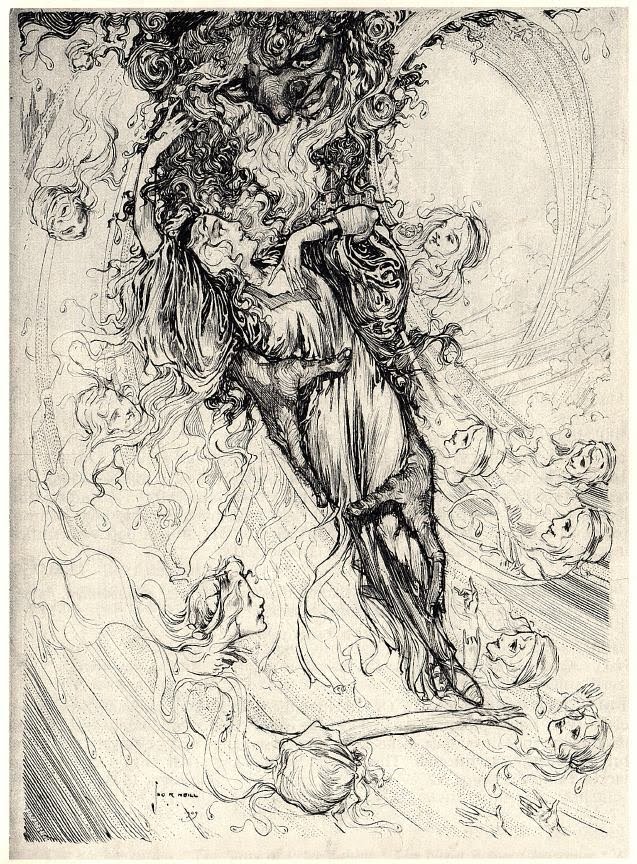
Since I've recently talked about Rainbow Brite and rainbow-related classical mythology, I pretty much feel obligated to discuss Polychrome, the Daughter of the Rainbow in the Oz series. I've mentioned her a few times, and of course she's in one of my icons, but I don't think I've done an entire post about her yet. [livejournal.com profile] bethje is always comparing her to Rainbow Brite, but while the cartoon character had an important job to do, Polychrome and her sisters really don't seem to have much to do beyond dancing. Still, Polly (as her friends call her) definitely increases in competence throughout the books, even if most of her actual growth is offstage. When she first shows up in The Road to Oz, she's presented as a beautiful and fragile creature totally out of her element. She accidentally danced off the end of the rainbow onto the ground, and she soon meets up with Dorothy's Oz-bound party. She's constantly in motion, and prefers to eat ethereal foods like dewdrops and mist-cakes. When she tries human food, she enjoys it, but eats only a very tiny bit ("about as much as a fly would eat," according to Dorothy). Polychrome dresses in robes that shine with all the colors of the rainbow, and while this is never specified in L. Frank Baum's text, John R. Neill consistently draws her with a skullcap.


When Polychrome returns for a brief appearance in Sky Island, she's hardly helpless, and instead assists the earthly visitors by arguing law with the Pinkies. Maybe her increased confidence has something to do with her being in her element (i.e., the sky), but it also seems like she's gained more practical knowledge.


The rainbow fairy's next role is in Tik-Tok, which reuses the plot device of her being stuck on the ground when the rainbow fades away. Oddly enough, when she meets the Shaggy Man, one of her companions in Road, she doesn't seem to recognize him at all. There's been much speculation on this point, with the generally accepted Oz-as-literature explanation being that this was a result of Baum's carelessness in adapting his play The Tik-Tok Man of Oz (which wasn't entirely consistent with the books, although it used many of the same characters) into novel form. Perhaps the best Oz-as-history explanation is that Polychrome was too upset to recognize Shaggy at first, but March Laumer's Careless Kangaroo contains a much more convoluted explanation about how she was in love with Shaggy, and decided to have her memories of him wiped out when it was obvious he didn't return her affection. This book also has her studying at the Wogglebug's college, which explains her increased intelligence in books after Road. An interesting aspect to Tik-Tok is that the Nome King seems to have a crush on Polychrome, although it's possible that he's bluffing.


The Daughter of the Rainbow shows up again in Tin Woodman, in which she's caught by the giantess Mrs. Yoop and transformed into a canary, and the Tin Woodman's party has to help her escape from Yoop Castle. Despite her foolishness in being caught, Polychrome is quite competent during this adventure, even while in canary form. She performs magic on several occasions, which is definitely a change from how she claimed not to know any magic back in Road.


The later canonical authors never gave Polychrome another prominent role, but they did seem to like her anyway, having her make cameo appearances from time to time. She assists characters in using the rainbow itself to reach Oz in Ruth Plumly Thompson's Grampa and Purple Prince, as well as Neill's Lucky Bucky. She and Kabumpo recognize each other in Purple Prince, and Wonder City has an episode in which Polly and Number Nine know each other from playing together on rainy days, so it's pretty much inevitable that the fairy made other unrecorded visits to Oz. I've seen rumors that Polly was a major character in Jack Snow's unpublished manuscript Over the Rainbow to Oz, but since this story has yet to turn up, there's no confirming that.


What exactly being "Daughter of the Rainbow" entails is never clearly specified. Polychrome refers several times to the rainbow itself as her father, but doesn't mention a mother. Both Marcus Mebes' Lurline and the White Ravens and a story in the most recent Oziana link the colorful fairy to Greek mythology by identifying her mother as Iris. Her uncle, as confirmed several times, is the Rain King. Gina Wickwar's contest-winning Hidden Prince features appearances by Polychrome and her uncle, as well as Paddy O'Paint, the leprechaun in charge of touching up the rainbow. Her also mentions another leprechaun named Kelly, who keeps the pot of gold at the rainbow's end.
vovat: (Polychrome)

Anyone who has read the second Oz book knows about Jinjur, the young Munchkin woman who led an all-female army in a revolt against the Scarecrow's government over the Emerald City, claiming that it had been ruled by men long enough. After the conquest, the girls spent their time eating caramels and plundering jewels. So much for female empowerment. Mind you, it was another girl, Ozma, who took the throne from Jinjur, with the help of Glinda and HER all-female army. Jinjur reappears in the next book, Ozma of Oz, now settled down on a farm and married to a man with nine cows. He doesn't actually appear, though, as he's nursing a black eye that he received when deciding to milk the wrong cow. Later books show Jinjur growing candy on her farm, and being a talented enough artist that she once painted new straw for the Scarecrow. Her husband never appears in these books either, however. The former general seems to be living alone in Tin Woodman, and her main companion in Neill's Runaway is a stallion named Jennifer. Is Jinjur's husband away most of the time? Does he prefer to stay out of the spotlight? Did they get a divorce? Or did he not even exist in the first place? We don't really know. I would, however, like to mention the Oziana story "Jinjur's Journal," in which the mysterious husband does appear, and is called Mr. Popp (no relation to the corkscrew of the same name, presumably).
vovat: (Woozy)

L. Frank Baum had an interest in reversing stereotypes, which was most obvious with the Cowardly Lion, but perhaps even more blatant with the odd couple known as the Foolish Owl and the Wise Donkey. I believe John Bell once listed the two of them as being akin to a married couple, which they sort of are, despite being different species, and so presumably not taking part in THAT aspect of marriage. They do keep a home together, and work as partners.


The Wise Donkey is actually a crossover character from another Baum fantasy, The Magical Monarch of Mo. In this book (specifically in the Fourth Surprise), we learn that he was once not very bright at all, but after being locked in a schoolhouse and eating all the textbooks, he absorbed the knowledge in them and became quite intelligent. He gives useful advice to the King of Mo and his subjects on various occasions throughout the book. When he appears in The Patchwork Girl of Oz, he explains that he was visiting Oz from Mo when Glinda placed an invisible barrier around the former land, resulting in his being stuck in Oz. He never specifies how he managed to cross the desert, but I'm actually thinking of making that a plot point in a manuscript I've started.

The Foolish Owl is presumably native to the Munchkin Country, being blue in color, and dressing in a blue sunbonnet. She (yes, the Owl is female, which people tend to forget) speaks in verse that's largely nonsensical, but does sometimes show insight into character. Both the Donkey and the Owl appear in [livejournal.com profile] dennisanfuso's The Astonishing Tale of the Gump of Oz, and I have plans to use them in a story myself, although I haven't actually written any parts for them yet.

Speaking of my own Oz writing, does anyone want to read any of my works in progress? Any input on them would be welcome, and I'd be glad to try to help out anyone else who's doing Oz writing.

December 2025

S M T W T F S
 123456
78910111213
14 151617181920
212223242526 27
28293031   

Syndicate

RSS Atom

Most Popular Tags

Style Credit

Expand Cut Tags

No cut tags
Page generated Jan. 4th, 2026 02:20 am
Powered by Dreamwidth Studios