vovat: (Minotaur)
Now that I've finished with my test, I have a chance to catch up on all the library books I recently checked out. I just finished this one today:


In Piers Anthony's continuing quest to bring back characters from earlier in the Xanth series, Jumper Cable not only makes several callbacks to Ogre, Ogre, but also features the spider Jumper from Castle Roogna. Okay, not exactly, because this Jumper is a descendant of the original one, but it's the same basic idea. If you've read any other Xanth books, you probably know what's in store here. Lots of puns (some relevant to the plot and some not), a quest devised by the Good Magician Humfrey, some Demon bets, several weird but hot mythological babes flashing their panties, and lots of pairing up. That said, despite its somewhat generic plot, there were some fun new ideas. Olive Hue's talent of bringing imaginary friends to live was clever, and we finally get to see a Maenad as a protagonist. The gag of Maeve incorrectly interpreting Haughty Harpy's bleeped-out profanity was funny, and I kind of wish it had continued past the first few chapters. Since the cosmic Demons with the names of planets had been established some books ago, making Pluto's demotion to dwarf status relevant to the story was clever. The formulaic adventures in the dream world became a bit tiresome, but otherwise this was a pretty good read.
vovat: (Minotaur)
Today, we take a look at the end of the world. More specifically, it's the final war of Norse mythology, Ragnarok. One fascinating thing about the myths of Ragnarok is that the descriptions are so specific, and the gods know all about them, but they're simply resigned to carrying out their roles. No point in messing with fate, I suppose.


According to the myths, the great war will be preceded by three years of harsh winter, during which morality will break down. Then the bonds holding some of the most fearsome monsters will break, and the creatures that have been trying to cause chaos for centuries will finally succeed. The wolves that have been chasing the Sun and Moon will devour them, and the serpent Nidhogg will chew through one of the roots of the World Tree. The monsters will join forces with the frost and fire giants, including Loki, who will escape from his prison. Sources mention two ships, one made of the nails of the dead, that will convey the giants and their allies to the final battleground; as well as the giants invading Asgard by way of the rainbow bridge Bifrost, which would break behind them. The gods will be assisted by the Einherjar, the virtuous dead who had been dwelling at Valhalla. The exact order and location of the events seems to vary from one source to another, but the last battle will be fought on the plain of Vigrid, which is ten thousand square leagues in area, and fills the same basic role that Armageddon does in Christianity. While we know that Armageddon refers to Megiddo in Israel, where many battles have been fought over the centuries, I haven't seen any speculation as to whether Vigrid might be a real place. At some point in the fighting, the wolf Fenrir will kill Odin, who will in turn be avenged by his son Vidar. Thor and the Midgard Serpent Jormungand will take out each other, with the thunder god killing the serpent but falling to the dead snake's venom. Eventually, after many more deaths on both sides, the giant Surtr will end the whole thing by setting all nine worlds on fire with his magic sword.


As is generally the case with mythology, this death of everything is followed by a rebirth. Some of the younger gods will survive the destruction, as will two humans, who will repopulate the world. In the new world, crops will grow by themselves, and peace and happiness will reign. The main dwelling place of the new gods will be Gimli, a hall that shines more brightly than the sun (and the source of the name for the main dwarf in Lord of the Rings). I seem to recall seeing some different takes on the new world from after Christianity started to gain prominence in Scandinavia, in which there's only the one god after the Aesir die. While an interesting way to try to reconcile old and new beliefs, wouldn't that mean Ragnarok would have to have happened already without anyone noticing? ("Hey, did you hear that a giant wolf ate the sun the other day?" "No, I was inside all day.")


The Norse apocalypse has become a popular theme, and the name "Ragnarok" has also been used for things that don't have an immediate connection to the end of the world. Indeed, most of the Google results I found when searching for the term did not refer to the battle, but to the RPG Ragnarok Online. Other references that come to mind are the Esper Ragnarok from Final Fantasy VI, Ragnarok Canyon in Battletoads, and the avian villain Ragna Roc in Piers Anthony's Two to the Fifth.

vovat: (Kabumpo)
[livejournal.com profile] countblastula had a meme up about which authors he'd read the most books by, and that seems like a pretty cool activity. I'm actually not sure who my top author would be, though. L. Frank Baum would definitely rank pretty highly, and I've read most of his fantasy, but surprisingly little of his other works (no Mary Louise or Boy Fortune Hunters, for instance). Terry Pratchett would also have to rank up there, as I've read every Discworld book plus Good Omens. There are times when I read more by series than author, although if I like one series, I'll sometimes branch out into an author's other work. Let me try for a Top Five:

1. Terry Pratchett - 38 - Thirty-seven Discworld books (including the young adult ones), plus Good Omens (co-written with Neil Gaiman, but I'm counting it anyway)

2. Piers Anthony - 32 - All of the Xanth books except the latest one, which I'm working on now.

3. L. Frank Baum - 28 - Fourteen main Oz books, Queer Visitors from Oz, Little Wizard Stories of Oz, Mother Goose in Prose, The Magical Monarch of Mo, Dot and Tot of Merryland, American Fairy Tales, The Master Key, The Life and Adventures of Santa Claus, The Enchanted Island of Yew, Queen Zixi of Ix, John Dough and the Cherub, The Sea Fairies, Sky Island, Policeman Bluejay

4. Ruth Plumly Thompson - 24 - Twenty-one Oz books, The Curious Cruise of Captain Santa, The Wizard of Way-Up and Other Wonders, Sissajig and Other Surprises

5. Douglas Adams - 8 - Five Hitchhiker's Guide to the Galaxy books, two Dirk Gently books, and The Salmon of Doubt

Actually, I think there might be some authors of Oz apocrypha (Chris Dulabone, for instance) in between the fourth and fifth, but I don't feel like counting those up right now. And I could easily be forgetting something.
vovat: (xtc)


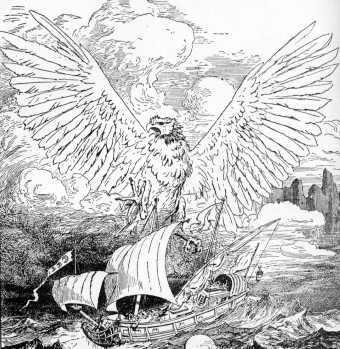
In my ongoing quest to highlight the most interesting of mythological creatures, it was pretty much inevitable that I would sooner or later come to the roc (also sometimes spelled "rukh"), that giant bird of prey. And when I say "giant," I don't just mean run-of-the-mill enormity. I mean a bird with legs the size of tree trunks, that can pick up full-grown elephants and rhinoceroses in order to eat them. Marco Polo mentions rocs in his own writings, but they're probably better known from their appearances in the 1001 Nights. When Sinbad the Sailor was marooned on an island where a roc nested, he had to use his family-friendly comedy routine to escape. No, he actually hitches a ride to another island on the roc's leg. On a later voyage, his crew disobeys Sinbad's orders and kills a baby roc, only to be bombarded with rocks by the parents. (Sinbad seemed to lose an entire crew on pretty much every voyage. Compared to him, Captain Kirk's track record was pretty good.) And if you're like me, you remember when Popeye fought Sinbad and cooked a roc in a volcano.

And since I try to take pretty much everything back to Oz, I feel obligated to mention that, in Captain Salt in Oz, the titular character tells his cabin boy of his desire to be a roc collector. He's heard that the birds nest on Rock Island (no, not the one in Illinois, but the one in the Nonestic Ocean, shown on the Oz Club's map to be some distance south of Peakenspire), and hopes to find a way to preserve a roc's egg and get it to the Emerald City. If it were to hatch, even a newborn roc chick (no, not the Debbie Harry variety; that's spelled differently) would be powerful enough to carry off his entire ship.

One fantasy series that makes extensive use of rocs is Piers Anthony's Xanth, probably largely because of how many puns you can make out of the word. (Hey, I've made at least three of them so far in this very post.) What with his tendency to come up with odd cross-breeds, I'm surprised we haven't yet seen him mention a Crocodile Roc or a Roc Lobster, but maybe they're coming in future books. Xanthian rocs actually don't seem to be anywhere near as large as the varieties that Sinbad and Samuel Salt were familiar with. I seem to recall one book suggesting that they were about the size of elephants, while the traditional roc was much bigger than that.

Anyway, roc on, everybody. And happy birthday to [livejournal.com profile] jenhime!
vovat: (Minotaur)
Well, I've now finished all of the Xanth books, and I guess I should review the last four, even though I'm not sure anyone will be interested.

Pet Peeve - This one was actually pretty good. The title character is a parrot-like bird who specializes in insults, and he's pretty amusing. Also in starring roles are a well-behaved goblin and a barbarian woman, who inadvertently cause an invasion of robots. This leads to a battle involving most of the tribes of Xanth, led by King Emeritus Trent. This is the first epic battle that's appeared in the series for some time, and I thought it worked well. I did, however, think Piers Anthony might have gone overboard in his strange pairings in that Hannah Barbarian ends up dating a robot. Hasn't she seen the propaganda video?

Stork Naked - Honestly, I felt this one was kind of phoned-in. The idea of alternate universes could have been neat, but Piers falls into the trap of spending more time describing the differences between universes than actually developing the plot. Besides, Xanth already has Princess Ida's worlds of ideas, so it kind of seems like overkill anyway. Also, I didn't find the characters too interesting. Surprise doesn't have much in the way of defining personality traits, and the half-demon kids are mostly just mischievous. And really, ANOTHER plot based around reproduction? It's like Piers has trouble thinking of anything other than babies in these more recent books.

Air Apparent - This one is a bit of an improvement. The story wasn't all that memorable, but it was nice to see starring roles for Hugo, Wira, and the Random Factor. Also, we find out that the moons of Ida make up an endless loop, and we get to see several more of them.

Two to the Fifth - Piers seems to have the same tendency in his books that I do in The Sims 2, which is to get characters to grow up and have children of their own as soon as possible. In order to hurry the next generation along more quickly, he does some stuff with a cyborg who was created as an adult, and an aging spell, resulting in a child from the future. Really, it gets kind of ridiculous, but the book wasn't bad overall. I thought the villain Ragna Roc, a bird with the power of deletion who considers himself a god, was pretty interesting. And the fact that it centers around an acting troupe allows for a different sort of plot (albeit with familiar elements). My favorite new character was Don, the wood-burning robotic donkey, whom I hope to see again in later books.
vovat: (xtc)
Today, in my weekly mythology post, I'm going to take a look at a symbol of rebirth. You're free to join me if you'd like, but I guess you don't have to. Anyway, the phoenix quite possibly originated in Egypt, but was often associated with India, because of its similarity to the bird-god Garuda. After 500 years of life, the bird would burn itself up, leaving behind an egg. It was often associated with the Sun, and not surprisingly, Christians came to use it as a symbol of Jesus' resurrection. It's also been commonly used in relatively modern fantasy, a few examples that immediately come to my mind being Edith Nesbit's The Phoenix and the Carpet, Dumbledore's pet Fawkes in the Harry Potter series, the life-restoring Phoenix Down in the Final Fantasy games, and the shape-shifting phoenix in Terry Pratchett's Carpe Jugulum.

What a phoenix looks like is never totally clear. Apparently, the Egyptians portrayed it as a stork-like bennu, and the Greeks and Romans as more eagle-like. Here are a few pictures that I found on the Internet:


The phoenix is also associated with the Persian Simurgh (also a character in the Xanth books) and two birds from Chinese mythology, namely the rooster-beaked Fenghuang and the Vermilion Bird of the South.


The former is the ruler of all birds, and the latter one of the Four Symbols found in Chinese astrology. The other three are the Dragon, the Tiger, and the Tortoise. And since I can't seem to get through a post these days without mentioning Oz, The Mysterious Chronicles of Oz gives the Original Dragon (who is introduced but not viewed onstage in Tik-Tok of Oz) the other sorts of animals as companions, only with a unicorn instead of a tiger. And that's a good transition into what I hope to talk about next week, which is the unicorn.
vovat: (Polychrome)
The topic of sex in Oz can be a controversial one, although I doubt there was any such controversy when the books were actually being written. I mean, come on, they're children's books from the early twentieth century! The argument comes in over whether writing more adult Oz stories is...appropriate, I suppose. There's also the question as to whether sex is even possible in Oz. Some people have taken the fact that Dot and Tot of Merryland is linked to Oz in a few books (most notably the visit of its queen to the Emerald City in The Road to Oz) to mean that the storks of Merryland bring babies to Oz. But then, it could be like the Xanth books, in which sex summons the stork. There's also the indication in Tin Woodman that even babies never grow older in Oz, which would probably make childbirth undesirable, if not impossible. We do see a child born in Oz in Ruth Plumly Thompson's books, however, so it apparently happens sometimes, even though I would imagine the birth rate is pretty low there. Besides, lack of childbirth doesn't have to mean lack of sex, especially if the country has birth control. And really, why wouldn't it? It's hardly a new idea, and magic might have made birth control devices more effective more quickly. Obviously it isn't mentioned in the books, but neither are bathroom facilities (well, bathtubs are, but not toilets), and it's likely there are some.

So why don't we see the number of sexual stories for Oz that we do for other fandoms? Well, part of it might be the relative obscurity of the books (except for the first one), but there's also the fact that a lot of the protagonists are either children or magical constructs with no apparent sex organs (which doesn't mean they aren't capable of romantic relationships; the Scarecrow and Patchwork Girl flirt quite a bit upon meeting, and some readers have compared the Scarecrow and Tin Woodman in Tin Woodman to an old married couple). It's possible to make the children grow older, especially with Thompson's idea that people can age if they choose to, but it still seems kind of wrong. I've seen some people pair up an older Ozma and Dorothy, which kind of makes sense, given how close they are in the books. March Laumer, the most famous and successful writer of more adult Oz books, gives Ozma unrequited romantic love for Dorothy, who goes on to marry a guy named Zippiochoggolak.

Ozma is definitely one of the more popular characters to involve in pairings. I guess that, as someone with beauty, brains (well, okay, that kind of depends on the book), and power, she'd be one of the most eligible bachelorettes in the country. She's young, but not AS young as many of the other main characters; Tin Woodman says that she's physically about fourteen or fifteen years old, and she might have even aged a little since then. Jack Pumpkinhead has Baron Mogodore trying to marry her, and while he's a villain, there's no indication that he's a pedophile. I believe it was David Hulan who suggested that John R. Neill started drawing Ozma as looking more mature after that.

For the purposes of comparison )

So I don't really object in principle to Ozma being in a relationship, it's a tricky task, and I don't think the stories I've seen that paired her off with someone (usually a Mary Sue) really pulled it off. I mean, not only is she a beloved character, but she's the ruler of the most powerful nation in the region. Her marriage would result in a significant change to the status quo, even if she didn't want it to.

Anyway, speaking of sexuality in Oz, look where Private Files' left hand is. )
vovat: (Victor)
Hey, my third post today! Can you tell I'm bored? :P This is something I'd been wanting to do anyway, though, and here's an excuse!

[Error: unknown template qotd]

Top Ten Albums of 2008:

1. Ditty Bops - Summer Rain
2. Ben Folds - Way to Normal
3. Amanda Palmer - Who Killed Amanda Palmer?
4. Vermillion Lies - What's in the Box?
5. Black Francis - Svn Fngrs
6. PiƱataland - Songs for the Forgotten Future, Volume 2
7. Colin Meloy - Colin Meloy Sings Live!
8. Magnetic Fields - Distortion
9. Sloan - Parallel Play
10. Dresden Dolls - No, Virginia

I haven't listened to some of these in a while, and it's possible my opinions will change when I do, but it's still a good indication as to what new albums I heard this year.

I'll also list books, but unlike the albums, none of these were actually RELEASED this year. That's just when I read them.

Reading is fun! )
vovat: (Minotaur)
Okay, I might as well go ahead and do another Xanth review, since I've read five of the books in the series since last time I did this. These are the twenty-fourth through twenty-eighth volumes about that vaguely Floridian magic land.

The Dastard - I found the villain in this one pretty interesting. He trades his soul to a demon for the power to change history, but he isn't really evil in his use of this power, just a total jerk. During the course of the plot, he travels with a half-dragon girl, and has to battle the Sea Hag (the main villain in the earlier Golem in the Gears), who has escaped from the Brain Coral. The Hag really isn't that significant to the plot, though, and seems to be there primarily so her that Piers can compare her variety of evil to the Dastard's milder deeds. It's a good story, but I think the idea of grown-up versions of the three daughters of Ivy and Grey who are children in ordinary Xanth is overly confusing and convenient at the same time. See, there's a separate world where everyone who has the potential to exist in Xanth lives, and after introducing this place in Faun & Games, Piers seemed to have the need to use it in every subsequent book.

Swell Foop - In order to rescue the captive Demon Earth, a motley assortment of characters has to track down the magic rings that will enable them to find the Swell Foop, an artifact that can control Demons. Not one of the more memorable books in the series, but an enjoyable read nonetheless.

Up in a Heaval - Like Roc and a Hard Place, this one visits a lot of the characters and locations from the earlier books, this time by making a Demonic construct deliver letters all over the country. It also gives Jenny Elf's cat Sammy a role apart from Jenny herself.

Cube Route - By this time (and this is the twenty-seventh book in the series), it seems like Piers was somewhat bored of Xanth itself, and had to introduce new worlds. Not only is there another visit to the moons of Ida, but the book also introduces Counter Xanth, and there's a crossover with one of Anthony's other series. I haven't read any of the Apprentice Adept books, but the brief visit to Phaze in this story is fairly short and uneventful, making it seem like more of an advertisement than a real plot point.

Currant Events - I think this book was more successful than some of the other later ones, at least partially because it focuses on aspects of Xanth that he'd already established but never really explored, rather than concentrating on new lands. Piers had mentioned a few times that the nine Muses from Greek mythology make their home in Xanth, and that Clio, the Muse of History, is the real writer of the books. Here, we finally see Clio as a main character. Since this IS a Piers Anthony book, part of it involves her hooking up with another character, but the relationship between somewhat older Xanthians is a nice change from all the young lovers we've been seeing. There's also an odd mixture of mythologies, in that not only do the Muses appear, but so do Paul Bunyan and Morgan le Fay.

The local library doesn't have the next book, Pet Peeve, and I'll probably wait until after the holidays to locate a copy. After that, I think there are only three more Xanth novels currently out on the market. In the meantime, I've found a few other things to read.
vovat: (Minotaur)
I'm not sure anyone has been reading my ongoing reviews of Piers Anthony's Xanth series, but I'm going to keep writing them anyway, if only for my own benefit. Here are my thoughts on the twentieth through twenty-third volumes:

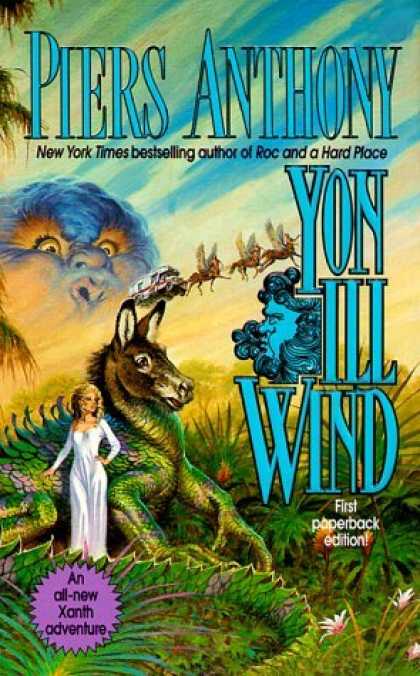
Yon Ill Wind - The demon who is the source of all magic in Xanth is challenged by his fellows to take mortal form. It's a typical incarnating god story, except for the fact that the Demon's avatar is a dragon with a donkey head. It's described as an ugly creature, but I think it actually looks kind of cute in the cover art. This being, known as Nimby, helps to guide a Floridian family through Xanth, and stop a hurricane that's devastating the land. Not all of the members of the mundane family are that well-defined, but I did find the idea of a relatively normal American family (most of the previous Mundanes to visit Xanth have been somewhat quirky) taking a road trip through the magical country. It's weird that there are drivable roads and sources of gasoline in a country that doesn't have cars of its own, but I guess just about anything is possible with magic. The book also shows us the evil cloud Fracto finally doing something helpful, and a community of imps with names reminiscent of those in one of L. Frank Baum's Little Wizard Stories.

Faun & Games - A faun and a former night mare journey to some of the tiny worlds located within Princess Ida's personal moon. The new rules that Anthony comes up with for each world are interesting, but he spends so much time describing these new locations that there isn't much room left for a plot. Not that I haven't had that same problem when writing my own stories. This one wasn't one of my favorites in the series.

Zombie Lover - Sort of a message story, in that a black girl named Breanna has to learn to overcome her own prejudice against zombies. Also, two familiar characters find spouses. That's a plot device that tends to be overdone in these books, but I did like Jenny Elf's romance with a werewolf.

Xone of Contention - Through the magic of the Internet, a troubled Mundane couple comes to Xanth, and Nimby visits the United States. Oh, and the characters fool around a lot. It's not as bad as that description makes it sound, but it's not one I would recommend anyone start with. As with most of the other volumes written around this time, it follows up on plot threads from several earlier books, mostly Demons Don't Dream, Yon Ill Wind, and Zombie Lover.

I'm still working my way through the series, and the next one, The Dastard, is pretty good so far. Overall, I have to say that I quite enjoy the series as a whole, but the books taken in and of themselves really vary in quality. And does EVERY character have to get married and have children? Sure, it's a good way of populating Xanth with new generations of characters, but you'd think SOME main characters would prefer not to become family men or women. But then, maybe that's just my opinion as a weirdo who doesn't want kids.
vovat: (Minotaur)
I've read the next three of Piers Anthony's Xanth books, and I noticed the trend of bringing back old characters in this part of the series. In the earlier books, Anthony seemed to be in kind of a hurry for new generations of characters to grow up and have their own adventures and relationships, so there are long gaps in time between many of them. This leads to the side effect of the earlier heroes growing old. By the time that Tor started publishing the books, the main characters from the first two books were almost a century old, and had great-grandchildren. But there was a still some story potential for them, so what was an author to do? Well, in this case, Anthony used magic elixir to restore their youth. (It's actually sort of the same thing I do with the elixir in The Sims 2, restoring my older characters so that they're sometimes younger than their children and grandchildren.) It's kind of a cheap technique, but since it had already been established that the Good Magician Humfrey was using such magic, it wasn't like it just came out of nowhere. Anyway, here are some thoughts on the specific books:

Harpy Thyme - This time, it's the Magician Trent whose youth is restored, but the main character in the book is the goblin-harpy cross-breed Gloha. Overall, it's a pretty standard Xanth adventure, with another character seeking an appropriate spouse, and encountering a lot of pun-filled adventures on the way. There are a few odd twists, though, like a giant suffering from bone marrow cancer. Fortunately, this being Xanth, there's a magical way of healing him, and a happy ending in store. I do have to wonder why the characters have such trouble finding a trans-plant, though, when you'd think Trent would just be able to transform something else into one. We also see the Demoness Metria, a succubus with vocabulary problems who helps or hinders mortals whenever she finds it interesting, finally settle down into married life.

Geis of the Gargoyle - Not all of Metria's demonic mind is satisfied with this arrangement, however, so her alternate personality Mentia splits off and has adventures of her own with a water-purifying gargoyle named Gary and the youthened Sorceress Iris. The story is pretty odd even for Xanth, in that most of it takes place in the ruined city of Hinge in the Region of Madness, and involves the main characters playing roles in an illusory reenactment of ancient Xanthian history. According to the author's note, one of the main points of this excursion is to resolve some contradictions in the series, sort of like Thief of Time did for Discworld.

Roc and a Hard Place - Speaking of restoring old characters, this one includes characters from nearly every previous book, and ties up a fair number of loose ends. The main character this time is Metria (with her alternate personality Mentia once again attached), who is ordered by the Simurgh to summon others to take part in a trial. During the course of this adventure, several characters get hitched (I'm not sure it's possible for any Xanthian NOT to end up marrying and having children, which allows for some interesting matches, but also gets a bit repetitive after a while), the curse on Threnody is broken, we learn the significance of Che Centaur and the egg being hatched by Roxanne Roc, and such characters as Arnolde Centaur and Ichabod the Archivist make their first major appearances in some time. Like Question Quest, in addition to being an interesting story on its own terms, it also provides a good overview of the series so far. Seeing the trial itself was also interesting, although I doubt most court cases in Xanth work out that way. I think it occasionally suffers from trying to cram in too much, though. For instance, while I found the Book of Kings fascinating, its appearance had nothing to do with the plot, and should probably have been saved for a later book. Still, this was probably my favorite Xanth book since Question Quest.

I've read the first chapter of the next book (at the time I originally wrote this, anyway; I've read considerably more of it since), Yon Ill Wind, so expect a review of that one sometime soon. Not that anyone cares, most likely, but I'm sure I'll keep writing them anyway.
vovat: (Woozy)
Dragons first appear in the Oz series in the fourth book, Dorothy and the Wizard in Oz. They're actually dragonettes, a term for young dragons that I thought Baum had invented, but stuff I've seen on the Internet suggests otherwise. They reappear several times after that, and I must say that John R. Neill had an unusual way of drawing them. Most of the ones in the Oz series are shown with crocodile-like heads, which doesn't appear to be based on anything in the text. Honestly, I think it gives them kind of a goofy look.

By the way, the game Tales of Destiny, which I've never played, has a dragon enemy named Quox. That must be a Baum reference, right? Quox is the dragon from Tik-Tok of Oz, who lives in a fairyland on the other side of the world from Oz, where dragons are respected, and the Original Dragon makes him home. In Oz itself, on the other hand, most of them are imprisoned underground and only allowed to come to the surface and hunt once per century, although a few of them have integrated into polite society. The Neill books actually have quite a few dragons living in the Emerald City, including the polite two-headed dragonette Evangeline (one of her heads is Evan, and the other Geline, but nobody seems to know which is which). According to Quox, dragons in the Oz universe have fire inside of them that keeps them alive, and Ruth Plumly Thompson expanded that idea to make at least some fire-breathing dragons vulnerable to water. On the other hand, there's an old dragon in The Enchanted Island of Yew whose flame goes out and needs to be lit again, so it's not entirely clear how the internal flame works.

There are some dragons in the Oz books and related volumes who don't breathe fire. Ojo in Oz has an appearance by a blue dragon sent by the Snow Dwarves to freeze Crystal City (not the one in the DC area), who runs around the city like a train. A similar comparison is made between Enorma from Grampa in Oz (who is a fire-breather) and an express train to Atlantic City. This book was written in the twenties, and it shows its age because the rail line to Atlantic City now runs quite slowly. But anyway, comparisons between dragons and trains aren't limited to Oz. The Xanth books have a steam dragon who's clearly inspired by a steam locomotive, and while Piers Anthony has mentioned having read the Baum Oz books, I don't know that he's read any of Thompson's.

An interesting dragon in a Baum non-Oz fantasy is the Purple Dragon of Mo, who doesn't breathe fire (at least as far as I can remember), but does have raspberry jelly in place of blood, and a body that can be stretched like rubber. After the King of Mo gets fed up with the dragon's constant wicked deeds (mostly eating crops, although he also steals the King's head in one of the stories), his people stretch him really thin and cut up his body to use as fiddle strings. (This is one case where the people of Mo had to resort to violins.)

Also worth mentioning are the Auto-Dragons of Thi, mechanical creatures that pull chariots in the town. They're made in a factory, and given orders through music. And this was back when automobiles were still relatively new, proving once again that at least some parts of Oz aren't as technologically backwards as you might expect.
vovat: (Minotaur)
Happy birthday to [livejournal.com profile] sailorptah! Also to my sister, although I don't think she reads this. I really should get her a present, but my family is hard to shop for.

Anyway, I'm still working my way through the Xanth books. They're all quick reads, and I've gotten through four of them recently. Here are a few thoughts on those four.

Isle of View - Although the title appears to be a rip-off of L. Frank Baum's Isle of Yew, this is an enjoyable book, focusing largely on new characters. One of them is Jenny Elf, who comes from another world based on the ElfQuest graphic novels. I've never read any of those (I understand that [livejournal.com profile] therealtavie is a big fan), but I think it's a well-executed crossover that accentuates some of the differences between different fantasy universes (Jenny is taller than Xanthian elves, and isn't tied to an elm tree). She was actually named after a girl who had been hit by a drunk driver and become paralyzed. Also, we finally wrap up Prince Dolph's marriage dilemma, although the fact that the dilemma even exists shows that Dolph isn't all that bright. The other characters seem to be aware of this, though, and Dolph does make the obvious decision in the end. Really, though, I'm not sure why Dolph COULDN'T marry two women. I mean, this is a land where nymphs run around naked and people breed with animals, but polygamy is apparently out. I wonder what Queen Irene would think of gay marriage. Or does Xanth even have any homosexuals? Finally, I do appreciate that Gwendolyn Goblin and Che Centaur's problem is resolved through compromise, which seems to be a major theme in the series.

Question Quest - The Good Magician Humfrey, who had been missing from Xanth for some time, relates his life history. I appreciate the historical backdrop for the novel, and the fact that we finally get to see Humfrey as a viewpoint character. We see the events of the earlier Xanth books from his point of view, and while I've seen a review that says the recapping gets tedious, I like getting a different perspective on old plots. Besides, it's been a while since I've read most of those books, so it helped to jog my memory. It's a noble attempt to get everything established about Xanth to fit together, which sometimes requires Anthony to come up with a convoluted explanation for an apparent contradiction, but I guess that's pretty much inevitable in a series that had been running for so many volumes. I do think it didn't really work to have Lacuna announce her plan to reprogram Com-Pewter at the beginning, though, as it made the actual confrontation anti-climactic. That's a minor complaint, though, and I found this to be one of the better Xanth books I've read so far.

The Color of Her Panties - A somewhat embarrassing title to be caught reading in public, but I never had anyone say anything about it. This book focuses on the Adult Conspiracy, which is basically a combination of knowledge about sex and all the things adults tell kids without explaining why. The panties come in because, for some reason, seeing a woman in panties is more forbidden than seeing one totally starkers (as they say in the United Kingdom). Actually, I can kind of see that. Regardless, pretty much every Xanth book after Anthony started using child protagonists (all the main characters in the first two books were adults, which makes it kind of weird that it eventually morphed into such an adolescent-themed fantasy land) incorporates the Adult Conspiracy, and it gets a bit tedious. Still, this book isn't bad, although it seems like Anthony stopped even making an effort to make each book work as a self-contained story. I mean, yes, it has a beginning and an ending and all that, but most of it is devoted to tying up loose ends from earlier books, and introducing some that would come into play in future volumes.

Demons Don't Dream - I didn't much care for the setup of this novel. It was largely intended to promote a computer game that came out around the same time (and, based on what I've seen in online reviews, isn't anywhere near as good as the book makes it sound, but that's only to be expected), so the plot focuses on two American teenagers who get into Xanth by means of the game. Within the book, the game is being run by demons, and actual people and places in the country are modified to provide challenges for the players. While a clever explanation in a way, the fact that Anthony is trying to make it the real Xanth AND a game at the same time makes for some awkward writing and explanations. That said, once the plot actually gets going, it's not a bad story, and there are some quite clever parts. The introduction of a multiracial human society into Xanth is done in a rather heavy-handed manner, but I do like Sherlock as a character.

The next volume in the series, Harpy Thyme, does not appear to be available at the local library. Maybe I'll see if I can find a cheap copy on eBay. There are a few other things I might want to read before continuing with Xanth, though.
vovat: (Woozy)
I've now finished reading Man from Mundania, the twelfth book in Piers Anthony's Xanth series. It's been a while since I've read anything in this series, but I had trouble finding this particular volume, and didn't want to skip it and read ahead. I did that all the time as a kid (I didn't originally read the Oz or Narnia books in any real order), but I'm less apt to do it now. The Xanth books have never quite grabbed me in the way some other fantasy series have, perhaps because I never got the sense of realism from them that I did from some others, but they're fun for light reading (and I wouldn't be at all surprised if one of them includes a pun on the term "light reading" {g}). I do think Anthony is a bit too keen to work in gratuitous sexuality, what with all of the naked women and mentions of summoning the stork and Adult Conspiracies. Also, he seems intent on coming up with the weirdest couples possible. There probably isn't a need for Xanth fanfic with absurd pairings of characters, because the actual author has already given us a centaur mating with a hippogriff, and a half-human, quarter-ogre, quarter-nymph hooking up with a woman made of brass. And characters tend to pair up very quickly, even when love springs aren't involved. All this aside, though, I like the books I've read so far (some more than others; I can barely remember anything that happened in Centaur Aisle, for instance). Man from Mundania is actually one of the better ones. Grey and Ivy's romance, while admittedly pretty quick and easy, was more believable than some others in the series. I also liked the incorporation of the Time of No Magic and the Magician Murphy (from the second and third books, respectively), and the advancement in the search for the Good Magician Humfrey (which started two books previously, and I think continues for at least the next two). For what it's worth, I believe Anthony has admitted to being a fan of the Oz books, and I appreciate how he managed to incorporate some similar elements (the magic tapestry at Castle Roogna that is quite similar to Ozma's Magic Picture, punny names, just about anything you could want growing on trees, etc.) while not coming across as a rip-off.

I think Man from Mundania was the first book in the series to state that the Xanth books actually exist within the universe of the stories themselves, as tomes written and kept by the Muse of History in Xanth itself, and as fiction in Mundania. That's actually pretty similar to how it works in the Oz books, in which several characters have read about Oz before going there, and L. Frank Baum even came up with an elaborate story of getting news from Oz by means of a radio telegraph. I believe I've heard that Tarzan and Sherlock Holmes also eventually became aware of books being written about their adventures, but I could be wrong. But I think it's usually the rule that people in a work of fiction can't actually read or watch that same work of fiction. In a way, I kind of prefer it when they can, because if they're supposed to be taking place in our own world (which the Mundania and Great Outside World segments presumably are), those works that we assume to be fiction presumably WOULD exist. On the other hand, it can make things too easy if strangers to a place already know a lot about it simply by reading, and the whole concept can come off as rather self-gratifying for the author. ("See? My books are so popular that even the characters in them read them! And if you haven't read all of them yet, here are some titles, worked right into the story!") It's an interesting issue, really.

December 2025

S M T W T F S
 123456
78910111213
14 151617181920
212223242526 27
28293031   

Syndicate

RSS Atom

Most Popular Tags

Style Credit

Expand Cut Tags

No cut tags
Page generated Jan. 3rd, 2026 05:14 pm
Powered by Dreamwidth Studios