vovat: (Default)
The line "release the kraken" from the commercials for the Clash of the Titans remake seems to have caught the attention of the nation, especially among people who think the phrase sounds like a euphemism for doing number two. I never saw the first Clash all the way through, and I'll probably wait until the remake comes out on video to see that. I do know that neither movie is really all that accurate to the original myths, so I'm sure it surprises no one that the kraken is not a part of Greek mythology. The monster that Perseus killed in order to save Andromeda is referred to as a "ketos," or in Latin form, "cetus." This appears to simply mean "sea monster" in Greek, but according to Wikipedia, the mythical monsters were portrayed as giant fish with some serpentine features.

The term has since been applied to whales, with our word "cetacean" obviously deriving from the Greek. There are several species of whale inhabiting the Mediterranean, and most of them are the toothed kind rather than the baleen variety (the fin whale is an exception), so I suppose they could theoretically eat a person. This also calls to mind the creature that swallowed Jonah, referred to as a "great fish" in the Hebrew, but popularly called a whale. I have no idea whether the author of Jonah would have known that whales weren't fish, or whether he had any particular species in mind for Jonah's captor.


The constellation Cetus is found among several others from the story of Perseus, so it's presumably supposed to be seen as the one slain by the hero. The group of stars is now typically called "the whale," although as with with most constellations, it really doesn't look like much of anything.

Still, its association with a sea monster is an old one, with ancient Babylonian astronomers identifying it with Tiamat.


The kraken actually comes from Norwegian folklore, and there are a few different indications as to what it might be. It appears that the earliest known mentions of the monster are from the eighteenth century, and refer to the kraken as a crab-like monster the size of an island, which eats smaller fish, but also nurtures their growth with its excrement. In popular culture, however, the kraken is generally thought of as a gigantic octopus, possibly based on the real giant squid. As with most mythical sea monsters, encounters with them are incredibly dangerous and usually fatal.

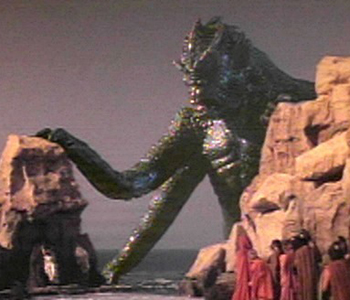
While I don't know about the new Clash film, the monster in the old one doesn't at all resemble an octopus or even a crab, so I guess they just used the name "kraken" because it's more familiar to modern audiences than "cetus."
Ad Oztra

Dec. 15th, 2009 08:59 am
vovat: (Polychrome)
When we see stars in the Oz series, they aren't the heavenly balls of plasma that we now know they are, but rather more of the pointed objects in the sky that are common in artistic interpretations. They do vary somewhat, however. Tik-Tok's story of Mr. Tinker in Ozma of Oz says that he was picking stars for the king's crown, implying that they were small objects. As I mentioned yesterday, Maribella in Grampa shepherds stars across the sky. In Cowardly Lion, the Flyaboutabus is wrecked when it crashes against a day star, and the terrier encountered on Un belongs to a boy on a star. Wonder City includes a visit to a chocolate star, which I described a bit in this post. Perhaps the most interesting portrayal of an Ozian star, however, appears in Runaway, in which Scraps and Popla find themselves on a rather high-tech mechanical star. It's piloted across the sky by Captain Battery Batt, a man made of coils of electrical wire, and one button turns it into a shooting star for faster travel. The light of this star comes from many rows of lightbulbs, which are polished by Captain Batt's companion, the Twinkler. The impression given is that there might well be other steerable shooting stars with their own captains and twinklers in the skies above fairyland. I like to think they might be products of a lost civilization.


While on the topic of heavenly bodies, I should also mention Princess Planetty. Oh, and her old homeland, Anuther Planet. In Silver Princess, Ruth Plumly Thompson plays with the idea of life on other planets by creating a dull metal world where the people emerge fully grown from vanadium springs. Vanadium, a transition metal that's the twenty-third element on the periodic table, was named after the Norse goddess Freyja's alternate appellation Vanadis. The similarity of the name to that of the Roman Venus, as well as the fact that Freyja is said to be the Norse equivalent of Venus, perhaps could be seen as a suggestion that Thompson was thinking of the birth of Venus when coming up with this idea. Anyway, the people of Anuther Planet, known as Nuthers, usually keep to themselves, although they do sometimes have animal companions. Planetty's is a Thunder Colt named Thun, who accompanies her to Earth and Oz. The Nuthers are armed with staffs that can paralyze others, and they have to bathe in a vanadium spring once a week in order to remain alive. Jinnicky manages to turn Planetty and Thun into flesh and blood, and the princess marries King Randy of Regalia. As for Anuther Planet itself, Planetty's story of how she reached Earth is that Thun jumped on a thunderbolt and rode it down to Ix, suggesting that it might well be another world located in the sky above fairyland. It's also possible, however, that it actually is a planet in the sense that we generally use the word, and the so-called thunderbolt is really some other sort of space phenomenon.

Lunar Lore

Nov. 21st, 2009 04:06 pm
vovat: (Minotaur)

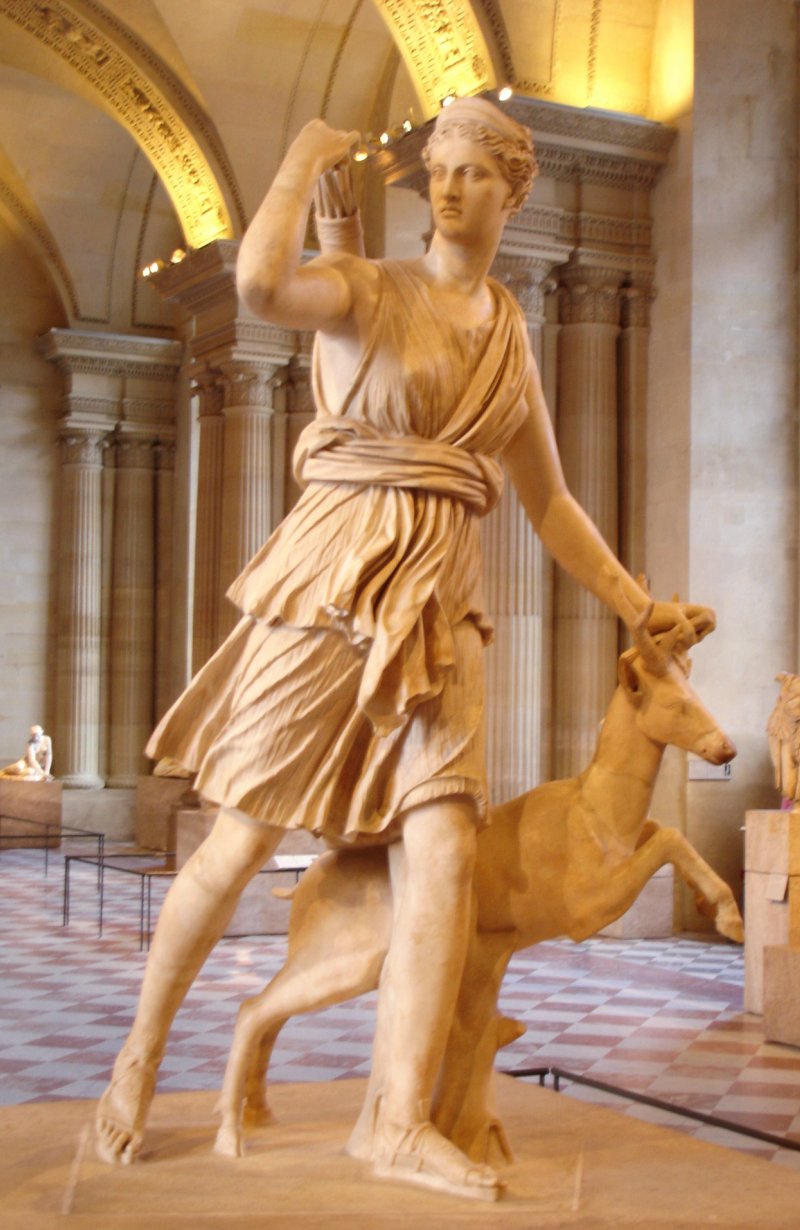
In honor of the discovery of water on the Moon, I thought I'd look into the mythology of Earth's favorite natural satellite. (Yeah, I know it's our ONLY natural satellite.) The best known mythological conception of the Moon is probably that of Greco-Roman lore, in which both the Sun and Moon are gods riding in chariots across the sky. In earlier mythology, these gods are the Titans Helios and Selene, but they are gradually replaced by members of the Olympian pantheon. Apollo came to be associated with the Sun, which means that his twin sister Artemis took over the Moon. There is some speculation that the Moon was represented by a woman because of the connection between the lunar phases and the menstrual cycle, but apparently male lunar deities were actually more common. The interesting thing, however, is that the Sun and Moon were pretty much inevitably opposite genders. In Norse mythology, for instance, Sol (the Sun) and her brother Mani (the Moon) are pursued across the sky by wolves. The Sumerians, however, seem to have considered both heavenly bodies to be male.


Some versions of the myth of Hercules and the Nemean Lion say that the lion, who in this telling was the son of Zeus and Selene rather than Typhon and Echidna, fell from the Moon. That seems to indicate that, at some point in the history of the ancient Greeks, they started thinking of the Moon as a location instead of just a chick in a chariot. What different ancient cultures thought about the size of the Moon, and how many of them thought the Moon actually was a person as opposed to there being a person living IN the Moon, would definitely be an interesting subject of study. I have to admit I don't know a whole lot about it, but the concept of the Man in the Moon suggests that said Man lived there, rather than actually BEING the satellite itself. The Man in the Moon is an example of pareidolia, the phenomenon in which humans see pictures where none were intended. The human mind is particularly fond of faces, and the full moon does resemble a person's face, with Mare Imbrium and Mare Serenitatis as the eyes. Other interpretations, however, saw the image of a person carrying something. Variations on this theme identify the figure as the guy stoned to death for picking up sticks on the Sabbath (see Numbers 15:32-36), a sheep or tree thief, Cain carrying a pitchfork, a witch carrying wood, and an old man with a lantern. Many of these associations are to Judeo-Christian culture, but it's said that the Haida of modern-day northwestern Canada and Alaska saw the moon-person as a disobedient boy gathering wood.


In Asian cultures, it seems to have been more common to see a toad or a rabbit in the Moon. I remember being intrigued when, in junior high school, I read a mention in Jorge Luis Borges' Book of Imaginary Beings to a Lunar Hare that kept the herbs used to make the elixir of immortality. The association of the Moon with immortality elixir appears to be pretty common. Hindu mythology holds that the life-granting elixir known as soma was stored in the Moon, and the satellite waned because the gods were drinking it. A Chinese myth involves Chang'e, who swallowed the immortality pill meant for her husband, and ended up living on the Moon with a rabbit companion. According to Wikipedia, the command center at Houston referred to Chang'e (as Chang-o) in a conversation with the Apollo 11 astronauts. The rabbit or hare himself was also sometimes said to manufacture elixirs.


Before we leave the Moon for the time being, I'd like to look at one more ancient belief about the Moon, which is that it's made of green cheese. Not surprisingly, the evidence suggests that no one ever actually DID believe this, but rather made fun of other people by claiming that THEY did. It was sort of a quick and easy reference to hoaxes and superstitions in general. So why green cheese? The Moon certainly doesn't LOOK green, after all. That, at least, might well have an easily explained answer. In 1546, John Heywood recorded the proverb, "The moon is made of a greene cheese," but "greene" probably actually meant new and unaged.
vovat: (Minotaur)


Continuing with the bear theme, today's mythology post is about two constellations always visible in the Northern Hemisphere (meaning that they're visible year-round, that is, not in the daytime or anything), Ursa Major and Ursa Minor. The association of these two groups of stars with bears was common in and around the Middle East, and apparently among some Native American tribes as well. I've read that most of the constellations we know were originally conceived by the Babylonians, so the idea might well have spread from there to Greece and Judea (the Great Bear is mentioned in the Book of Job), but that doesn't explain how the Iroquois had the same idea. In Western Europe, the most recognizable part of what is considered Ursa Major is more commonly seen as a plow or wagon, or sometimes a cleaver or saucepan. Some Africans (ones in the Northern Hemisphere, I suppose) identified the seven main stars as a drinking gourd, which is presumably where we get the modern American idea of the Big Dipper.


The Greek myth surrounding the two Ursa constellations involves a nymph named Callisto, daughter of Lycaon of Arcadia, and part of the retinue of Artemis. Our horny old pal Zeus was attracted to her, and some versions of the myth say that he took the form of his own daughter in order to rape the girl. Regardless of the details, Zeus and Callisto had a son named Arcas, and Hera took her revenge for her husband's infidelity by turning the nymph into a bear. When he'd grown older and become a hunter, Arcas almost killed his ursine mother, but Zeus saved both of them by turning the hunter into a bear as well. He then pulled them into the heavens to become constellations, stretching out their tails in the process. Some other takes on the myth say that Arcas was not transformed, but that he became the constellation Bootes. Anyway, the reason the two bear constellations never move below the horizon was that Hera made it so they could never have access to water.

vovat: (Minotaur)


In the year 2006, astronomers made two significant chances in the nomenclature of our solar system. Pluto was downgraded to a dwarf planet (I'm still not over that, mind you), and a slightly larger Kuiper Belt object that was previously known as "Xena" was given the official name Eris. But does this name really fit the usual naming rules for planets and planetoids? The names we use for the six planets visible with the naked eye come from the Romans. They're all named after gods, and while the fact that the Romans appropriated much of Greek mythology means that all of these gods had their Greek counterparts (Hermes for Mercury, Aphrodite for Venus, Ares for Mars, etc.), it was the Latin names that became the standard ones for our Sun-orbiting neighbors. When William Herschel discovered Uranus in 1781, he called it "Georgium Sidus" after the King of England, but its current name became the most commonly used one in the following century. While I'm not entirely sure of this, I've seen it suggested that the reasoning behind the name Uranus is that, in Greco-Roman mythology, Jupiter is the father of Mars and Saturn of Jupiter, so it only made sense to name the next planet after Saturn's own father. The odd thing about that, however, is that the Latin name for the primordial Greek sky deity was Caelus, with "Uranus" simply being a Latinized version of the Greek name Ouranos. Similarly, Eris is also a Greek name, with her Latin equivalent being Discordia. I believe the only rule for planet-naming is that they have to have the names of Greco-Roman gods, so these don't technically break that rule, but it seems like giving them the Latin names would have made things somewhat neater. The names of other planet-like objects have a mixture of mythological names and others, and I have to say it's a little unfair that significant deities like Juno and Minerva get no more than asteroids. Incidentally, both Vulcan (okay, actually "Vulcano") and Romulus, which were used for planets in other star systems in the Star Trek universe, are also both asteroid names.


Incidentally, according to the International Astronomical Union, stars don't officially have names, just catalog numbers. These are mostly determined based on constellations, which is a rather geocentric method, but I'm sure any other would be too insanely complicated. Traditional names are still in use for the brighter stars, however, many coming from Arabic, but others from Latin,Babylonian, and Chinese. There are also companies that name stars after people for money, but these are in no way official.

April 2026

S M T W T F S
   1234
567891011
12131415161718
19202122232425
2627282930  

Syndicate

RSS Atom

Most Popular Tags

Style Credit

Expand Cut Tags

No cut tags
Page generated Apr. 15th, 2026 06:25 pm
Powered by Dreamwidth Studios